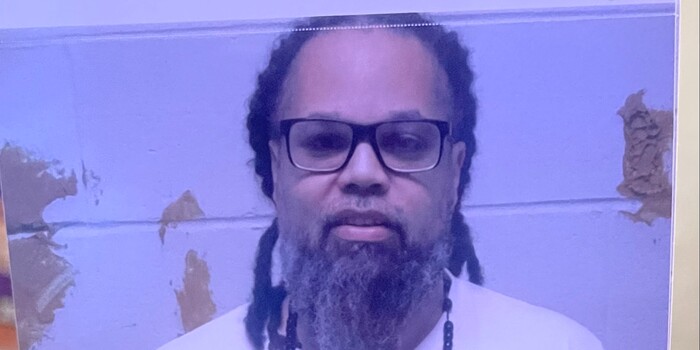
Editor’s note: This post began as a reader submission. We matched the reader’s description to a federal case using public court records, and everything below about the case comes from those records unless we say otherwise. Allegations from the reader and from published commentary are labeled as such. We have not verified them. If you are Mr. Reynolds’s family or have records from his case, please send them. They are the only way we can take this further.
A reader wrote to us asking for one thing on behalf of Donald Reynolds: that someone actually look at his case. The reader says Reynolds was “unjustly sentenced to life in prison” in Tennessee after “a speedy trial,” that his own lawyer “gave all of his evidence to the prosecution,” and that he has been fighting for more than 16 years to be heard. Above all, the reader writes, he wants to come home to his son.
The details match United States v. Donald Ray Reynolds, Jr., No. 3:08-cr-143, in the U.S. District Court for the Eastern District of Tennessee in Knoxville. Here is what that record shows, and what it doesn’t.
What the court record shows
Prosecutors alleged that Reynolds was a high-level trafficker who brought marijuana and cocaine from the western United States into East Tennessee, used a music business as a front, and kept cash deposits under the $10,000 reporting limit. After a trial that ran from February 22 to March 8, 2010, a jury convicted him on all counts. According to the Sixth Circuit’s 2013 opinion, those were 36 counts:
- one count of conspiracy to distribute cocaine and marijuana
- four counts of possessing a firearm in furtherance of drug trafficking
- three counts of possession with intent to distribute cocaine
- 17 counts of structuring cash transactions
- 11 money-laundering counts
On May 21, 2010, the trial judge denied his motion for acquittal or a new trial, rejecting each claimed trial error. On October 28, 2010, Reynolds was sentenced to life plus 900 months, or 75 years, to run consecutively. The appeals court noted that the sentence was within the federal guideline range.
The Sixth Circuit affirmed on August 8, 2013, but its opinion is not a clean bill of health. The court found that:
- much of a government expert’s testimony, including vouching for the cooperating witnesses and saying he knew Reynolds was a drug dealer (the last in answer to defense questions), “plainly was improper” and “prejudicial to the defendant”;
- a prosecutor’s closing remark tying Reynolds to Mexican cartels was the kind of appeal to the jury’s passions that “would constitute misconduct”;
- the argument that the evidence showed two separate conspiracies, not one, was “rather compelling”;
- the trial judge failed to make a required inquiry when Reynolds objected to his lawyers at sentencing.
It held that none of these required reversal, mainly because it considered the other evidence “overwhelming.” That evidence included testimony from several co-conspirators, a car dealer’s account of about $250,000 in cash vehicle purchases, an IRS agent’s analysis finding little legitimate income, and packaging from his trash that tested positive for cocaine. Reynolds was tried alone.
The court declined to decide his ineffective-assistance claims on direct appeal. It left them for a motion under 28 U.S.C. § 2255. He filed one in 2015. The district court denied it on February 26, 2018, then rejected his later efforts to reopen that ruling, and on February 8, 2021, denied a certificate of appealability. We have not been able to read the 2018 ruling itself, so we can’t yet say which claims it decided. A 2022 civil-rights appeal he filed is a separate matter; the Sixth Circuit docket shows that complaint was dismissed before anyone was served.
Drug trafficking on the scale alleged here harms real families and neighborhoods. That is exactly why the record matters. If this conviction is sound, it should stand. If it isn’t, a family has lost a son and a father to a process that failed.
The reader’s claims, tested against the record
“A speedy trial”
The public orders, available on GovInfo, show a case that was delayed, not rushed.
- December 2008: The trial had been set for December 16, 2008. The court granted a defense request to move it after the government acknowledged missing a discovery deadline. The time was excluded under the Speedy Trial Act. His lawyers argued that the discovery problems forced him “to choose between his right to a speedy trial and his right to the effective assistance of counsel,” and he filed a motion seeking sanctions for “Discovery and Speedy Trial Violations.”
- March 2009: His first lawyers withdrew. The court granted another defense continuance, again excluding the time.
- Through 2009: More changes of counsel followed, and trial began in February 2010.
The family’s concern may really be about readiness, not delay. The lawyers who tried the case appeared in August 2009, four months after the motion deadline. The appeals court later upheld the refusal to let them reopen a search-warrant challenge on the first day of trial. Four days before trial, they asked to withdraw and for a continuance. That request was denied. A reviewer would need:
- the full docket
- who asked for each continuance
- how the court ruled on the December 2008 sanctions motion
- whether any speedy-trial objection was preserved for appeal
“His lawyer gave all of his evidence to the prosecution”
No court has made such a finding, and nothing in the public opinions shows it. What the record does show is a badly broken relationship between Reynolds and his lawyers:
- His trial lawyers were his fourth and fifth attorneys, and he represented himself for part of 2009.
- His trial lawyers told the court that he had accused them of working with the government. At sentencing he said they were “colluding with the government.”
- His first lawyers withdrew over what the court called “an actual ethical conflict.” The reasons are under seal.
Context matters. Federal reciprocal-discovery rules can require a defense that requests the government’s evidence to share documents it plans to use at trial, so some disclosure can be routine. Under Strickland v. Washington, the question is what was disclosed, whether any rule required it, and whether it changed the outcome. Trial counsel’s file and the 2018 § 2255 ruling are where those answers would be.
The Nathaniel Smith affidavit
In commentary for The American Conservative, Arthur Bloom reported that Nathaniel Smith, Reynolds’s original co-defendant, signed an affidavit denying Reynolds’s involvement in drugs. Bloom’s March 2021 piece says the affidavit “wasn’t allowed to be presented at the trial.” His earlier article says Smith filed and then retracted it, and that it is “not clear” whether the retraction came under pressure.
The court record adds a crucial fact: Smith testified at trial as a government witness. We found no ruling on the affidavit in the public opinions we reviewed, and it is not among the trial errors raised in the 2010 new-trial motion. A reviewer would need:
- the affidavit and its date
- the retraction
- whether either was used to cross-examine Smith
- whether any court ever ruled on them
Physical evidence, and the family’s treatment
Bloom’s reporting also questions the physical evidence. He describes a “near-total lack of physical evidence.” Separately, he reports concerns from Reynolds’s parents about how federal agents treated them, which the U.S. Attorney’s office declined to comment on. The reader who wrote to us goes further. The reader says people who have tried to help Reynolds have been harassed, and believes there has been an effort in Tennessee to keep the case closed.
We have not verified any of these allegations. We are not suggesting that any judge, prosecutor, defense lawyer, or official acted improperly.
What a real review would take
This is a federal conviction, so the Tennessee state post-conviction process does not apply. The realistic paths are narrower:
- A federal post-conviction lawyer. His first § 2255 motion has been decided. A second one needs permission from the Sixth Circuit, and § 2255(h) allows that only for newly discovered evidence that would clearly and convincingly show no reasonable juror would convict, or for a new constitutional rule the Supreme Court has made retroactive.
- Compassionate release. Under 18 U.S.C. § 3582(c)(1)(A), a prisoner first asks the warden. After 30 days, or once administrative appeals are exhausted, he can ask the court to find “extraordinary and compelling reasons” for a reduction. The court must also weigh the sentencing factors. This route reduces a sentence; it does not decide innocence.
- Clemency. Commutation petitions go to the Justice Department’s Office of the Pardon Attorney. Bloom reported in 2021 that the office said no petition was pending.
- Innocence organizations. The Tennessee Innocence Project accepts only written applications from the incarcerated person, not family. The person must claim factual innocence, must have had a direct appeal denied, and must be unable to afford a lawyer. The national Innocence Project focuses on DNA cases and says it does not take cases that challenge only drug distribution charges. The Innocence Network directory lists other organizations.
Records change cases. Documents that surfaced years later were central to the Michael Morton and Edward Wright cases. Relief is still slow and uncertain. Eddie Williams won federal habeas relief and was convicted again at a retrial.
We’re listening
The reader says Reynolds “just needs someone to listen to him and actually look at his case.” We can’t promise an outcome. We can promise to read what you send. The most useful items are:
- the 2018 § 2255 ruling
- trial counsel’s file
- the Smith affidavit and its retraction
- the docket’s continuance orders
We keep personal information confidential unless you allow us to publish it.
Featured image: Howard H. Baker Jr. U.S. Courthouse, Knoxville, Tennessee. Photo by Antony-22 via Wikimedia Commons, licensed CC BY-SA 4.0. Resized.