By Unjustly Accused
In July 2006, a 48-year-old woman was found unconscious in a toilet cubicle at a nightclub in Doncaster, a suburb of Melbourne, Australia. She had no memory of how she got there. She was taken for a forensic medical examination, which is exactly what should happen when someone may have been assaulted while unable to protect herself.
Swabs from that examination were sent to the lab. A DNA profile was developed and run against the state database. It matched a 19-year-old Somali-Australian high school student named Farah Jama.
Jama had no criminal record. He did not drink. No one among the roughly 800 people at the club recalled seeing him. Security staff had never seen him. The woman did not remember speaking with him. There was no camera footage. There was only the DNA.
On July 21, 2008, a jury convicted him of rape. He was sentenced to six years. He would spend roughly 15 months in prison before the truth emerged: his DNA had never come from that woman’s body at all.
Case at a Glance
- Accused: Farah Abdulkadir Jama, 19 at the time
- Location: Doncaster nightclub; forensic examination at a Crisis Care Unit in suburban Melbourne, Victoria
- Date: July 2006
- Charge/Conviction: Rape; convicted July 21, 2008; six years, four non-parole
- Sole evidence: A DNA match from a forensic swab
- Exonerated: December 7, 2009, Court of Appeal of Victoria entered a verdict of acquittal
- Inquiry: Report by retired Supreme Court Justice Frank Vincent, 2010
- Compensation: A$525,000 ex gratia payment
What Went Wrong
One room, one doctor, two examinations
Roughly a day before the Doncaster examination, the same forensic medical officer, working in the same facility, had collected samples in an entirely unrelated matter connected to Jama. Those samples placed his DNA in the room, on the equipment, and in the database.
The Vincent inquiry concluded that contamination most likely occurred during the second examination, through equipment, surfaces, or instruments that had not been cleaned to a standard capable of removing DNA. Cleaning protocols at the time were designed around infection control, not the elimination of human genetic material.
Jama’s profile had been loaded into the database less than 48 hours before the match was reported. No one connected the two events.
In plain terms, the lab did not find Jama’s DNA on the woman. It found Jama’s DNA in a sample that had picked it up in an examination room.
The warning signs that were ignored
The Vincent report did not blame a single technician. It described a system in which every safeguard deferred to the DNA:
- No corroboration. Nothing else connected Jama to the club, the suburb, or the complainant.
- An alibi. Jama gave an account of where he was that night that placed him nowhere near Doncaster.
- An implausible profile. A teenager who did not drink, with no known ties to the area or the venue.
- A doubtful offense. Beyond the DNA, the evidence that a sexual assault had occurred at all was uncertain.
Vincent wrote that, at face value, “there would seem to be little, if anything, to attract a person of his age group and what is known of his social connections to such a place.”
And yet the prosecution told the jury the DNA could be relied upon beyond reasonable doubt. The match itself was never meaningfully tested against the collection history. The jury convicted.
“An Almost Mystical Infallibility”
The most quoted line from the Vincent report is also its most important:
“The DNA evidence appears to have been viewed as possessing an almost mystical infallibility that enabled its surroundings to be disregarded.”
He added: “The outcome was, in the circumstances, patently absurd.”
When the case reached the Court of Appeal, prosecutor Brett Sonnet conceded that a “substantial miscarriage of justice” had occurred. Chief Justice Marilyn Warren set aside the conviction and directed a verdict of acquittal on the spot.
The Science: Contamination Is Not Exotic
Contamination is often imagined as a rare laboratory catastrophe. It is not. Modern DNA testing is sensitive enough to detect a few cells, which means:
- DNA survives ordinary cleaning. Wiping a surface for hygiene does not necessarily remove genetic material.
- Shared instruments carry risk. Scissors, trolleys, lamps, and examination tables can hold DNA from a previous person.
- Database matches feel definitive. A “cold hit” lends a sense of certainty that discourages asking how the DNA got there.
- Context is not in the profile. An electropherogram cannot tell an analyst whether DNA arrived through a crime or through a dirty pair of scissors.
This is the same reality behind the case of Lukis Anderson, whose DNA reached a murder victim’s fingernails via paramedics who had treated him hours earlier, and the larger pattern we described in The DNA Illusion.
Timeline: From Examination Room to Acquittal
- July 2006: A woman is found unconscious at a Doncaster nightclub and taken for forensic examination. About a day earlier, the same forensic medical officer had collected samples in an unrelated matter connected to Jama, in the same facility.
- 2006: A DNA profile from the swab is matched to Jama in the state database, less than 48 hours after his profile was loaded.
- July 21, 2008: Jama is convicted of rape in the County Court and sentenced to six years, with a four-year non-parole period.
- 2009: Questions about the collection history emerge; the prosecution reviews the case.
- December 7, 2009: The Crown concedes a “substantial miscarriage of justice.” The Court of Appeal quashes the conviction and enters an acquittal.
- 2010: The Vincent report is tabled in the Victorian Parliament. Jama receives an ex gratia payment of A$525,000.
What the timeline shows is how little time passed between the two examinations, and how much time passed before anyone checked.
Reforms That Followed
Victoria adopted the Vincent recommendations, including:
- Sealed, single-use collection kits and improved cleaning procedures in forensic medical units
- Better documentation linking every sample to the person, place, and time of collection
- Training for police, prosecutors, defense lawyers, and judges in the limits of DNA evidence
- Consideration of DNA as one piece of evidence that must be tested against the rest of the case
Australia’s attorneys-general also established a national working party on DNA collection and use standards.
The Spradlin Parallel: The Same Plate, the Same Risk
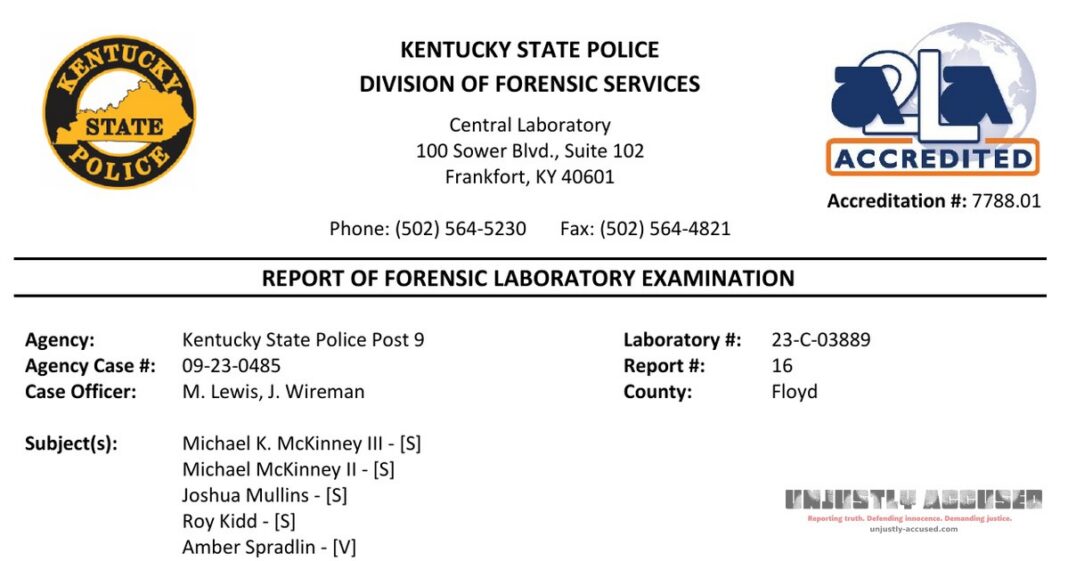
In Kentucky, Michael McKinney has been held for more than two years on charges arising from the death of Amber Spradlin. He is presumed innocent. As we reported in The McKinney Case: Forensics on Trial, an independent review commissioned by the defense found that known reference samples from McKinney and his father were run on the same plate as the victim’s fingernail clippings, raising what the reviewers called “the potential for carryover/contamination.” The same review reported a contaminated reagent blank that analysts continued to rely upon.
The Jama case does not tell us what happened in Kentucky. It tells us why those observations cannot be dismissed as technicalities. In Melbourne, a suspect’s DNA and a victim’s sample passed through the same room within a day, and an innocent teenager went to prison.
Key Questions and Systemic Issues
- Sequencing and separation: Are reference samples from suspects ever processed alongside evidence samples? Should they ever be?
- DNA-only prosecutions: Should any jurisdiction allow a conviction where DNA is the only evidence?
- Defense capacity: How many defendants lack access to an independent DNA expert who could probe a match like this one?
- Disclosure of collection history: Would the jury have convicted if told the same doctor had handled Jama-related samples the day before?
What Comes Next
Farah Jama received compensation and an indemnity for his costs. The complainant, who has never been publicly identified, was failed too: whatever happened to her that night was never properly investigated, because the case closed the moment the database reported a name.
Why This Case Matters
- A match is not a mechanism. DNA tells you whose genetic material is present, not how it arrived.
- Contamination can happen before the lab. Collection rooms and clinicians are part of the forensic chain.
- Every other fact pointed away from guilt. The system chose the DNA over all of them.
- Juries need context. Collection history is as important as the profile itself.
- Reform is possible. Victoria changed its procedures after an independent inquiry named the failures.
- Victims are failed too. A false match ends the search for the truth.
Farah Jama was convicted because a profile matched and no one asked why. DNA is not a timestamp, and it is not a story. When a sample’s history is ignored, the science stops being evidence and becomes a verdict in search of a defendant.
For a strikingly similar laboratory failure in England, where a negative control flagged contamination before a man was charged, see our forthcoming report on Adam Scott and a reused lab tray.
We will continue to examine how laboratory practice shapes outcomes in active cases. If you have information about a potential wrongful prosecution, use our story submission instructions; the ordinary web form does not guarantee anonymity.
Sources
- ABC News: DNA evidence not infallible (Vincent inquiry)
- Sydney Morning Herald: DNA fiasco — Farah Jama
- ABC Law Report: DNA debacle — the case of Farah Jama
Featured image: Supreme Court of Victoria, Melbourne. Photo: Donaldytong / Wikimedia Commons (public domain).