Breaking news. Updated Oct. 26, 2026.
The Kentucky State Police lab has finished the DNA testing that held up the Amber Spradlin murder case for more than a year. The final report doesn’t match M.K. McKinney III to a single item.
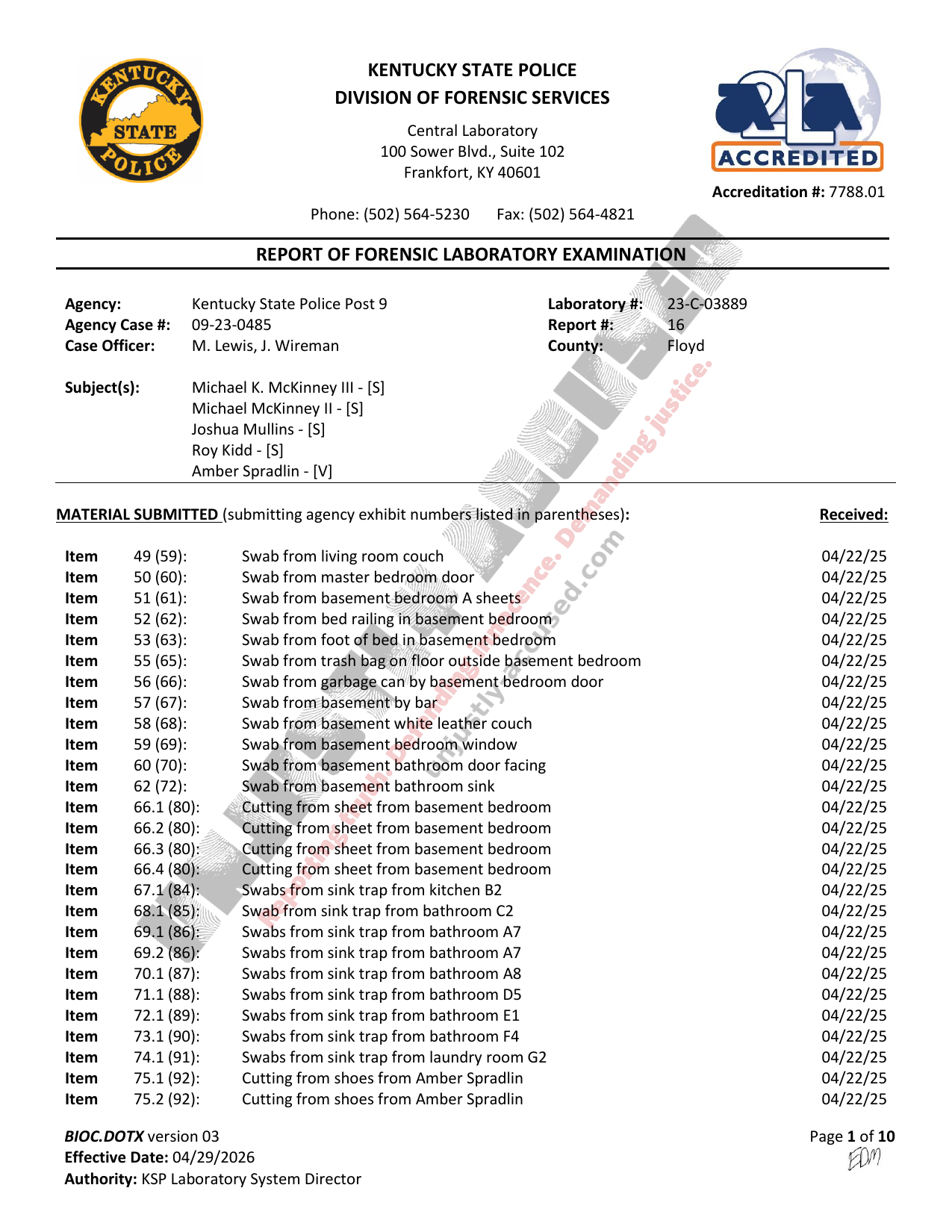
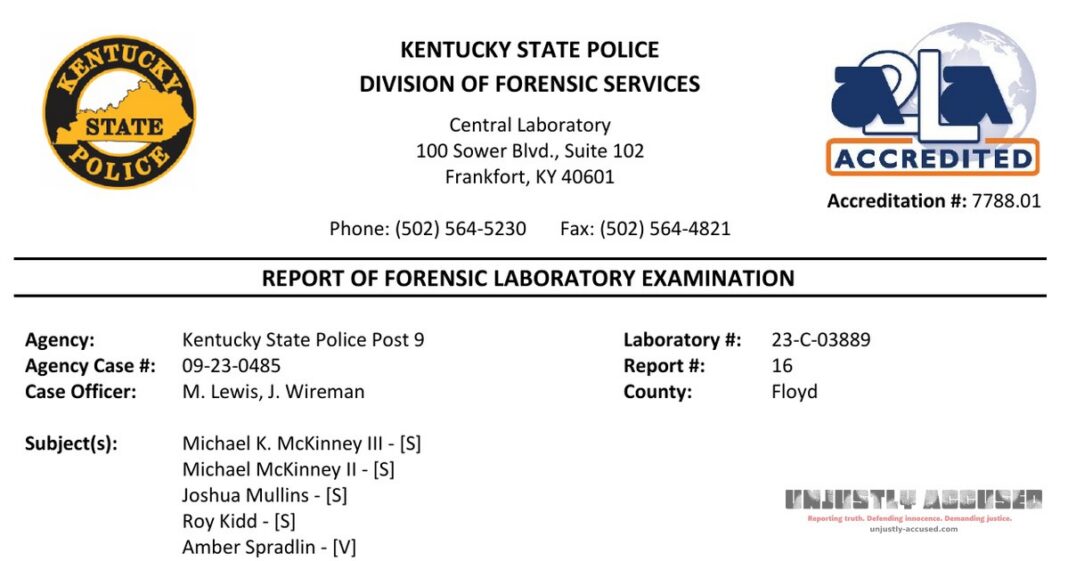
Report #16 from the KSP Central Laboratory in Frankfort was issued Oct. 22, 2026. Unjustly Accused obtained it from an anonymous source. It covers 33 items collected from the Arkansas Creek Road home in Martin and from Amber’s own clothing and belongings. Every item that produced a DNA profile the lab could compare excluded Michael “M.K.” McKinney III. The same is true of Dr. Michael McKinney II and Joshua Mullins, the other two men charged in the case.
The report links many of the comparable profiles to one person: Roy Kidd. He is Amber’s longtime friend, he was in the house that night, and he found her body. Roy Kidd has not been charged with any crime and is presumed innocent. As explained below, the lab itself says its results cannot show how or when any DNA got where it was found.
Trial is set for Jan. 11, 2027, before Special Judge Eddy Coleman in Pike Circuit Court (No. 25-CR-00223). All three defendants have pleaded not guilty and are presumed innocent. For the procedural picture, see our recent explainer, The Amber Spradlin Case: Will It Reach a Jury?
What Report #16 Is
The report carries KSP Laboratory # 23-C-03889 and agency case # 09-23-0485. KSP Post 9 submitted the case, and the case officers are listed as M. Lewis and J. Wireman. According to the report, the items were received on April 22, 2025. That is the same submission date we noted in our timeline of the crime scene investigation. Analysis began on May 1, 2026, more than a year later. It was completed Oct. 21, 2026, and Forensic Laboratory Supervisor Davey McCann issued the report the next day.
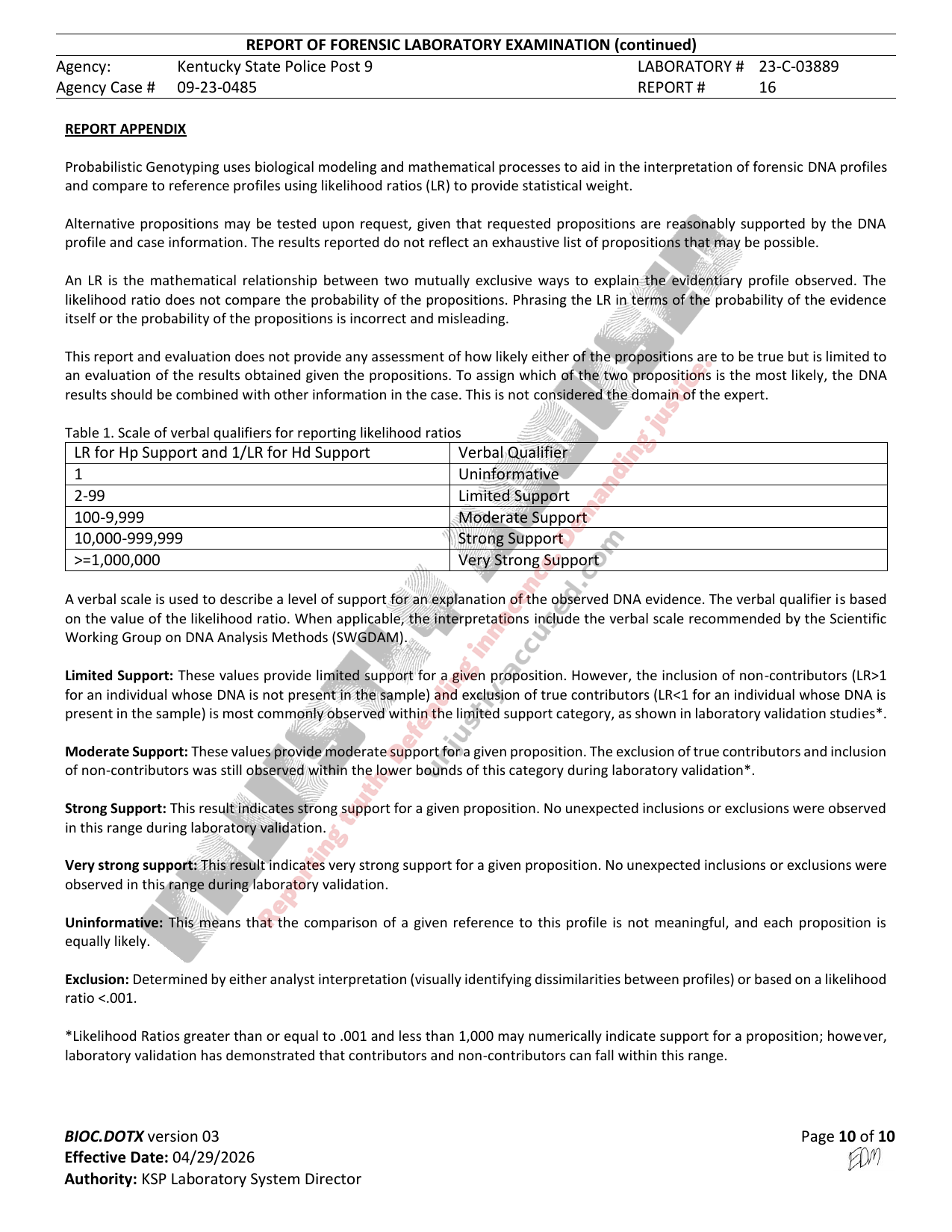
The lab compared the evidence with reference samples from Amber Spradlin, the three defendants, Roy Kidd, and one other person. Each result is reported as a likelihood ratio (LR). The report’s appendix warns that an LR “does not compare the probability of the propositions.” In plain terms, it describes how much better one explanation fits the DNA than another. It does not give the odds that any particular person is the source.
What the Lab Found
Amber’s own DNA
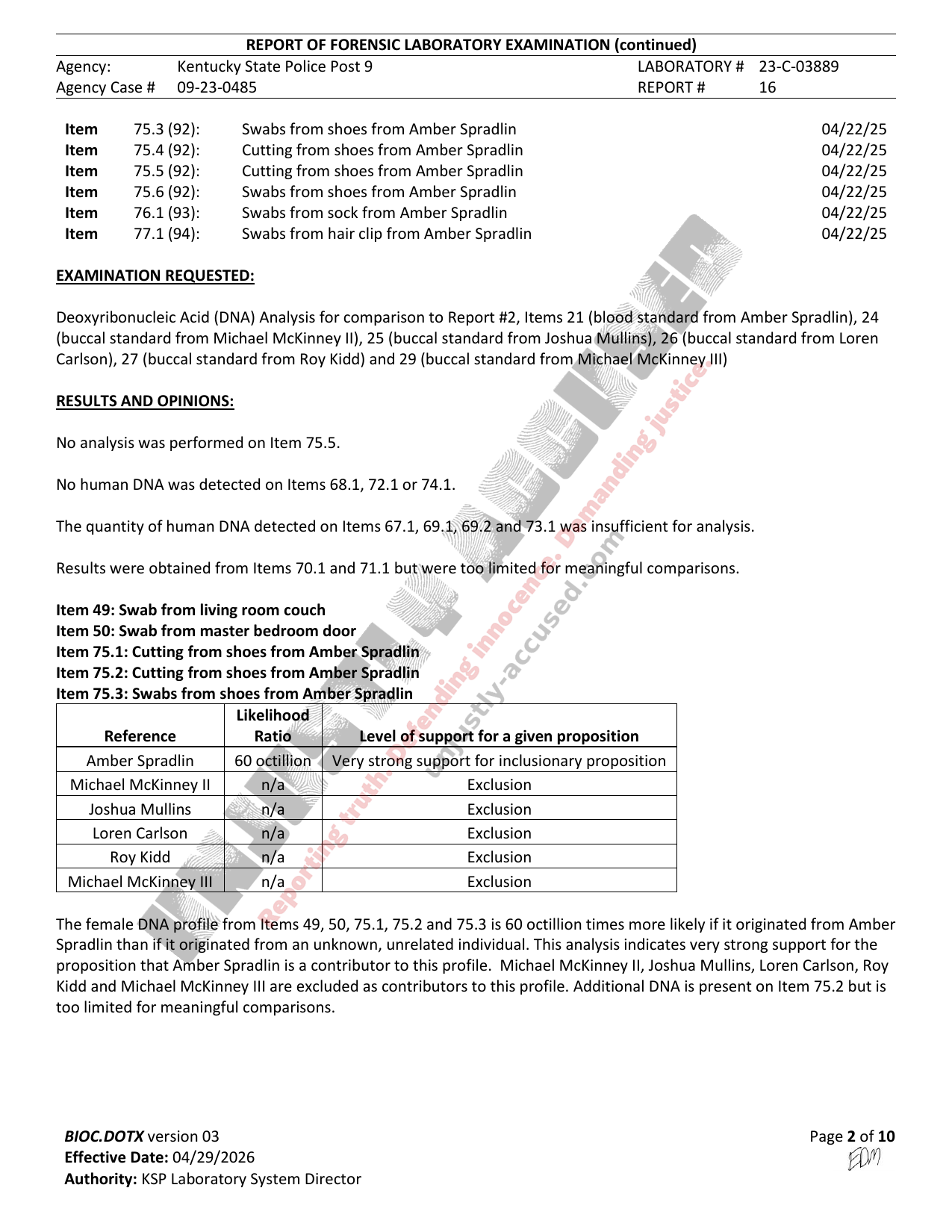
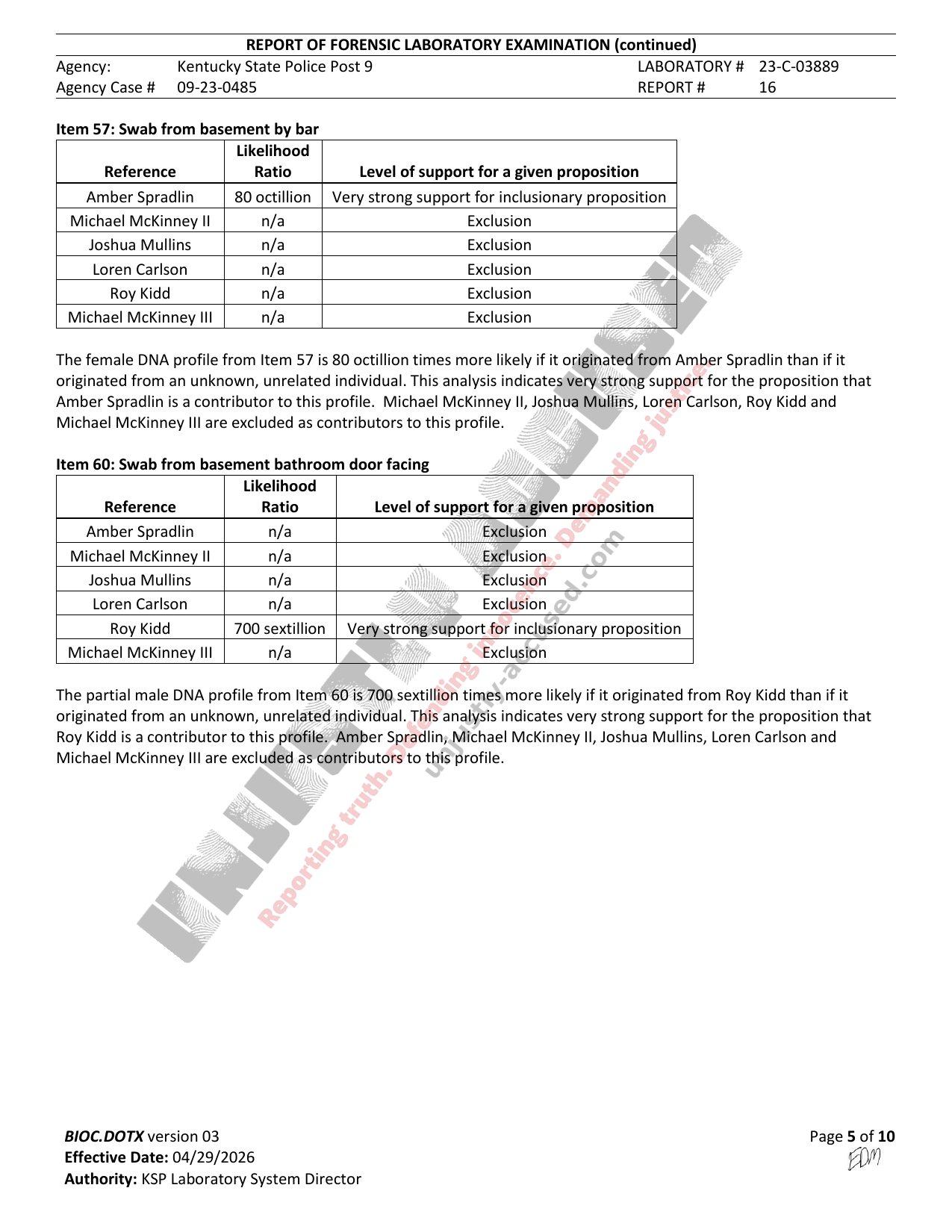
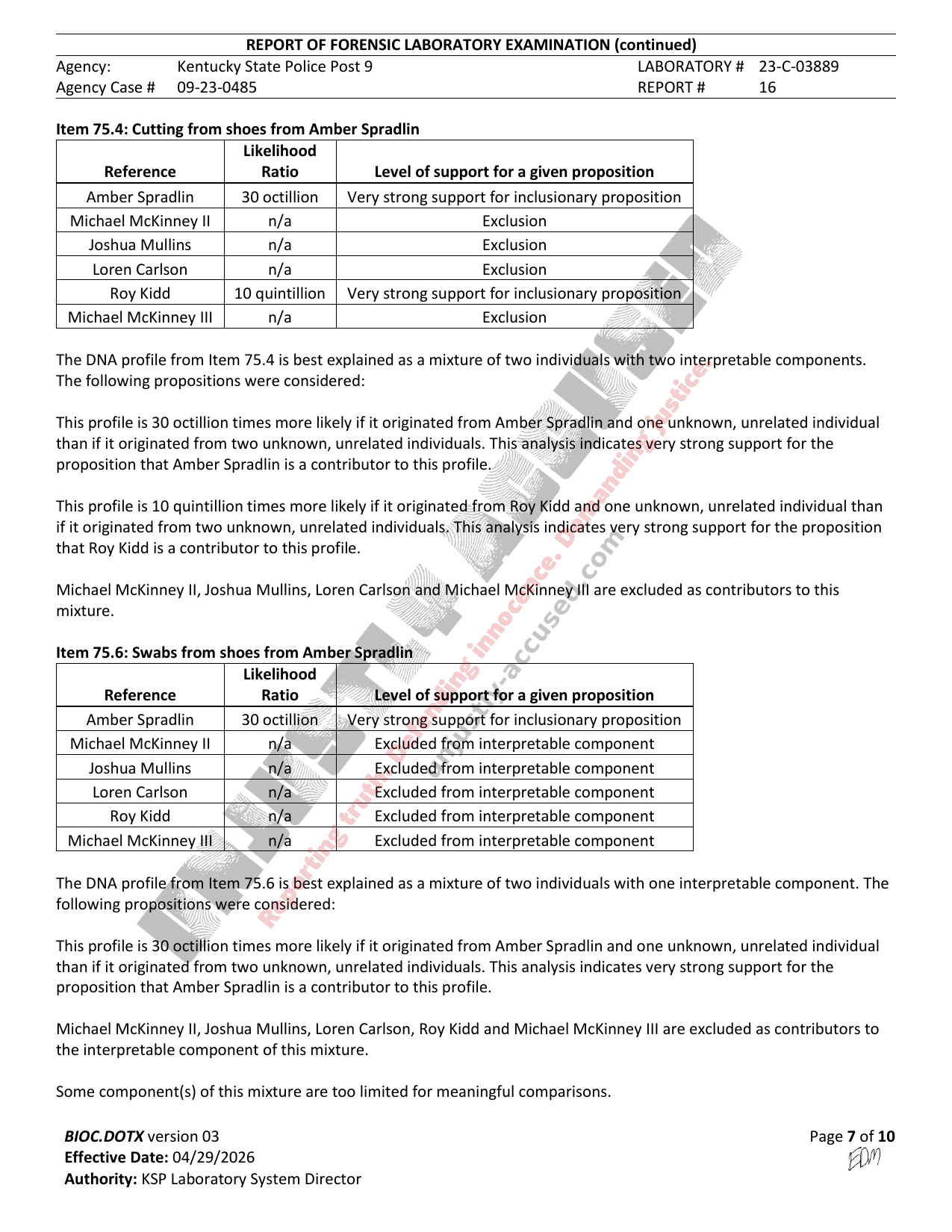
A female profile came from five items: the living room couch, the master bedroom door, and three samples from Amber’s shoes. According to the report, that profile is 60 octillion times more likely if it came from Amber than from an unknown, unrelated person. A swab “from basement by bar” gave a similar result. Every man compared, and the other reference, was excluded from these profiles.
Roy Kidd’s DNA
The lab reported “very strong support” that Kidd is a contributor on these items:
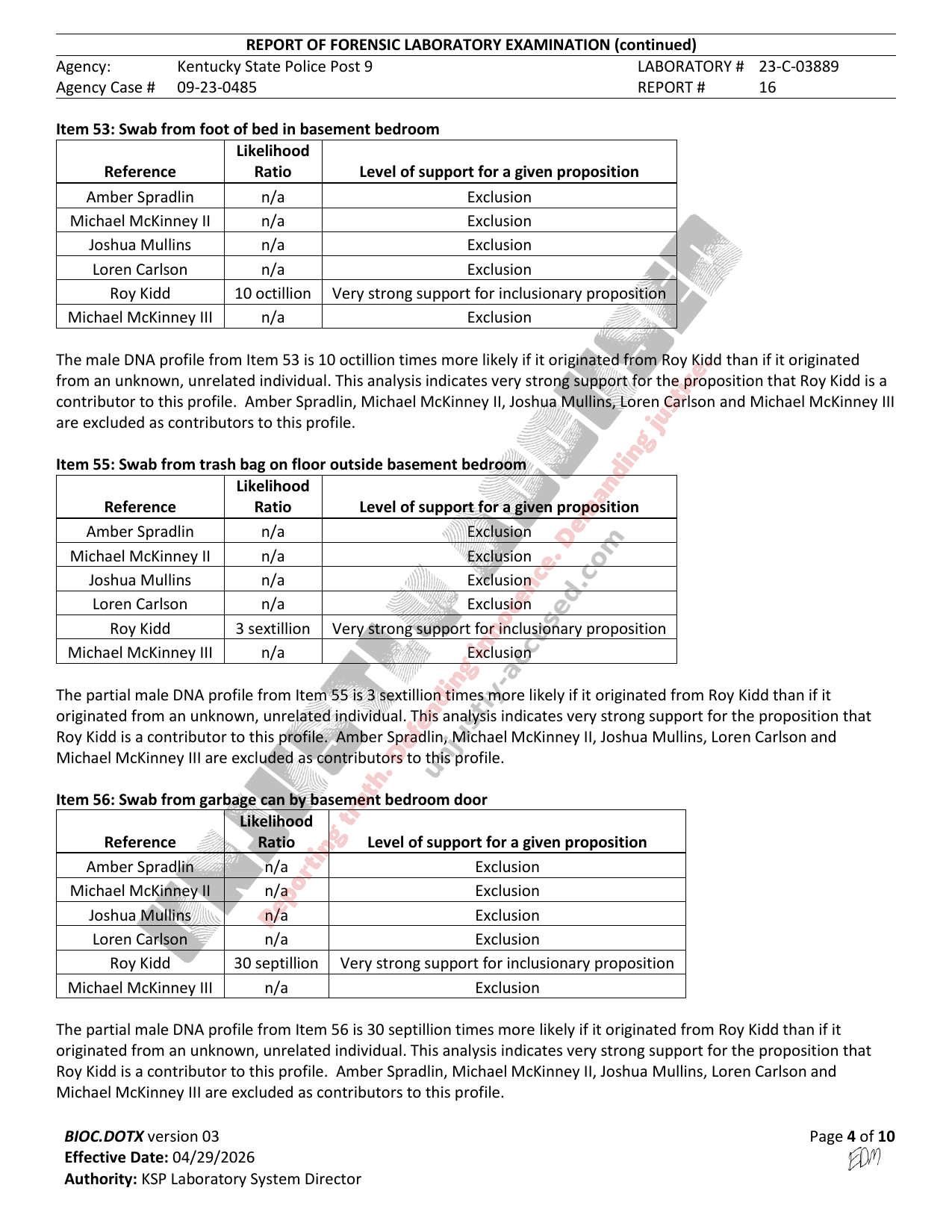
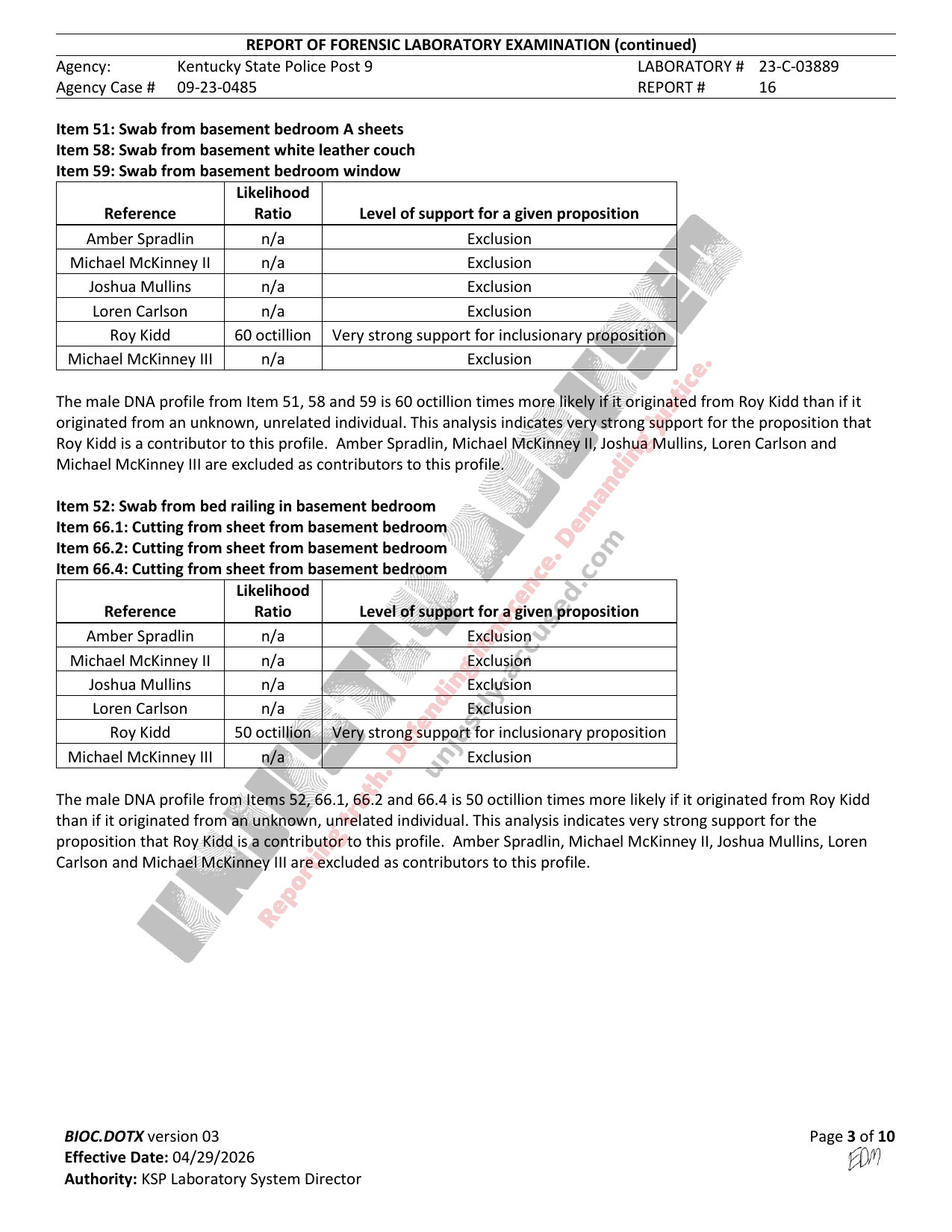
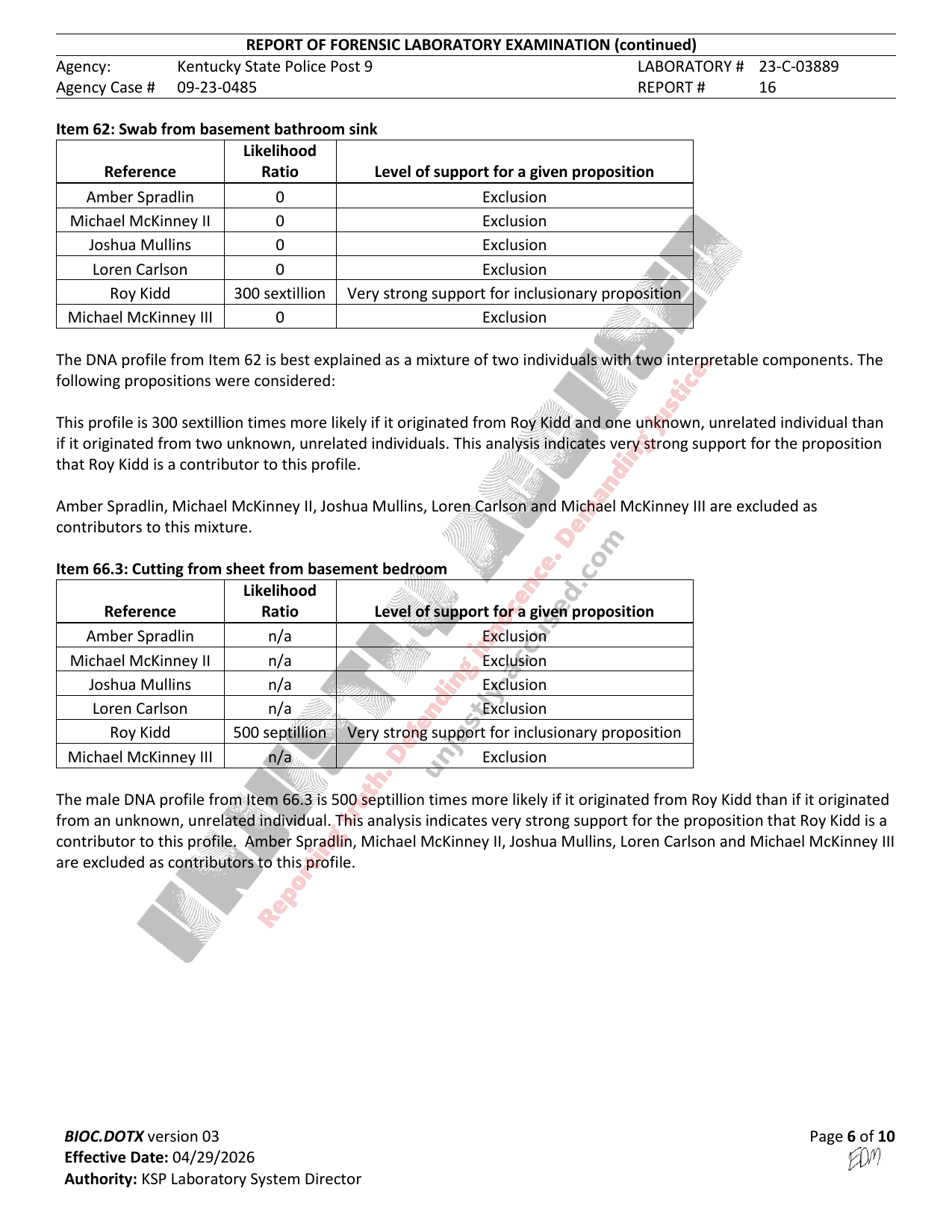
- Basement bedroom: sheets (Item 51 and four sheet cuttings, 66.1–66.4), the bed railing (52), the foot of the bed (53) and the window (59). The LRs range from 10 octillion to 60 octillion times more likely if the DNA came from Kidd than from an unknown, unrelated person.
- Basement common areas: the white leather couch (58), a trash bag on the floor outside the basement bedroom (55, partial profile), a garbage can by the basement bedroom door (56, partial), and the basement bathroom door facing (60, partial).
- Basement bathroom sink (62): a two-person mixture. The lab says it is 300 sextillion times more likely if it came from Kidd and one unknown, unrelated person than from two unknown, unrelated people.
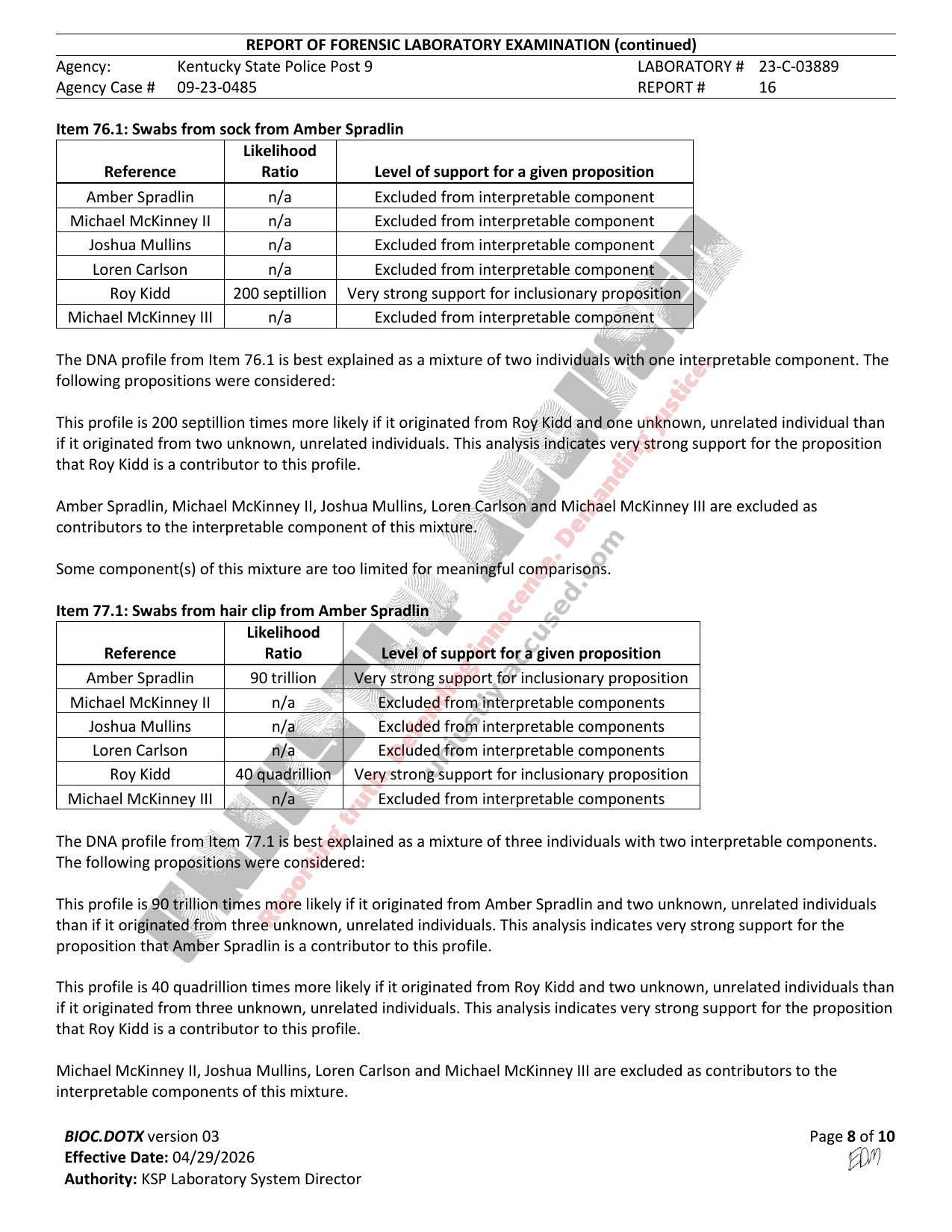
- Amber’s belongings: a shoe cutting (75.4, a mixture of Amber and Kidd), a sock (76.1, where Kidd is the only interpretable contributor and Amber is excluded from that component), and her hair clip (77.1, a three-person mixture with Amber and Kidd as the interpretable contributors).
The report does not identify any of these samples as blood or as any other body fluid.
The defendants
M.K. McKinney III, Michael McKinney II and Joshua Mullins appear in every results table in the report. In each one they are listed as “Exclusion,” or as excluded from the interpretable part of the mixture.
What couldn’t be compared
Not every item gave a usable result:
- Nine sink-trap samples from the kitchen, bathrooms and laundry room produced no human DNA, too little DNA, or results “too limited for meaningful comparisons.”
- Parts of several mixtures were also too limited to compare, including the hair clip, the sock and one shoe sample.
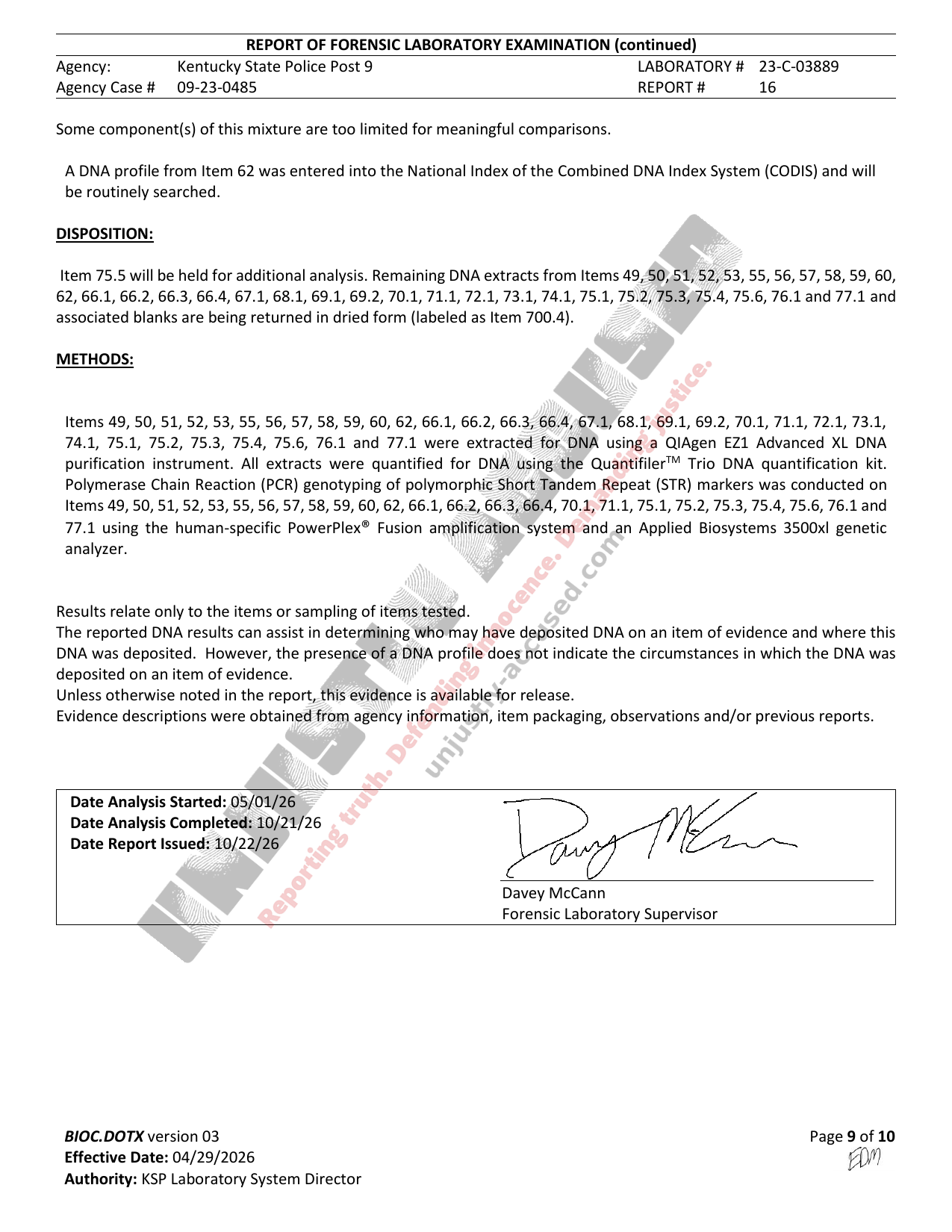
- One shoe cutting, Item 75.5, was not analyzed at all. The report says it “will be held for additional analysis.”
So the exclusions apply to the profiles the lab could interpret. They don’t cover every item.
An unidentified contributor, and CODIS
The basement bathroom sink mixture has a second contributor. Every reference compared was excluded as that contributor: Amber, the three defendants and the other reference. The report says “a DNA profile from Item 62” was entered into the national CODIS database “and will be routinely searched.” It does not say which component of the mixture was uploaded.
What the Results Do Not Say
The lab spells out its limits:
“The reported DNA results can assist in determining who may have deposited DNA on an item of evidence and where this DNA was deposited. However, the presence of a DNA profile does not indicate the circumstances in which the DNA was deposited on an item of evidence.”
The report also says the evaluation “does not provide any assessment of how likely either of the propositions are to be true.” Weighing DNA against everything else in a case “is not considered the domain of the expert.”
Those limits apply to everyone, including Kidd. DNA can be left by touch, by bleeding, or by secondary transfer through another person or object. This site has long argued that a DNA match alone cannot tell a jury what happened. We apply that standard here too. For more on the risks, see When DNA Deceives.
Roy Kidd: What the Record Shows
The public record already contains several facts that bear on how Kidd’s DNA could have reached these places:
- He was hurt and bleeding. In an interview with KSP detectives the day after Amber’s death, Kidd said he had been drinking heavily and fell “several times.” He said he cut his chin and wiped the blood on his shirt. The transcripts were filed in court and later published by Mountain Top Media. The Commonwealth has said the blood on his clothes was his own.
- The defendants helped him to bed, according to the Commonwealth. In a Sept. 15, 2026 filing, the Commonwealth said Kidd “fell and cut his chin in the basement well before the murder and had to be helped to bed by the Defendants due to his extremely intoxicated state.” It said this explains why his DNA appeared on clothing from two co-defendants’ bedrooms, as WYMT reported.
- He found Amber’s body and touched her. In the same interview, Kidd said he found Amber on the living room couch, “touched her shoulders,” and “shook her twice” before pounding on Dr. McKinney’s door to ask him to call 911. Contact like that could account for some of his DNA on Amber’s belongings.
- Where he slept is not settled in the public record. In the interview, Kidd said he slept in a bottom bunk in M.K.’s room on the main floor. He described the basement bedroom as where Mullins and his girlfriend stayed. The Commonwealth’s filing says he “had to be helped to bed” but does not say which bed. Report #16 does not say when or how his DNA reached the basement bedroom.
Kidd’s attorney, Timothy Parker, has said Kidd “has fully cooperated with the Commonwealth and authorities.” The Commonwealth’s position, reported by WYMT, is that DNA from Amber’s right-hand fingernail clippings excluded both Kidd and Mullins. We repeat: Roy Kidd is not charged, he is presumed innocent, and nothing in this report establishes who killed Amber Spradlin.
Why This Report Matters
The prosecution has framed this case as a contest between two explanations. In an April 2026 motion, Floyd Commonwealth’s Attorney Brent Turner wrote that “it is very likely that the whole case will come down to whether the jury believes the murder was committed by defendant MK McKinney or Roy Kidd.” He said evidence still awaiting testing “could literally make or break the case for the commonwealth or the defendants.”
The outstanding lab work is now complete. Its comparable profiles from the scene and from Amber’s belongings point to Amber herself, to Kidd, and to one person the lab could not identify. None of them point to M.K. McKinney III. The DNA evidence the Commonwealth has publicly cited against M.K. centers on a Y-STR result from Amber’s fingernail clippings. That result can’t tell apart McKinney men in the same paternal line, and the Commonwealth has described it as 463 times more likely. A Y-STR profile is shared across a paternal line, so it is far weaker evidence than the autosomal profiles in Report #16.
None of this decides the case. But it raises questions that the court, the parties and the public deserve answers to:
- Why did testing take so long? The items reached the lab in April 2025. Analysis didn’t start until May 2026, and the report arrived less than three months before trial. At a May 2026 hearing, McCann testified that 145 items were submitted in this case, far beyond the lab’s “preferred limit” of about 10, as the Floyd County Chronicle & Times reported.
- Does the Commonwealth’s theory still fit? Kentucky law lets a prosecutor amend, dismiss, or seek a continuance. We walk through those options in our trial explainer.
- Who is the unidentified contributor on the basement bathroom sink? And will the CODIS search answer that before January?
- What will Item 75.5 show? It is a cutting from Amber’s shoes that the lab is still holding.
Pretrial conferences are scheduled for Oct. 30 and Dec. 4. For the full history of the case, see our investigation timeline: charges before DNA.
Amber Spradlin’s family has waited more than three years for answers. They deserve a result built on the evidence, and so do the people accused.
The Full Report
All ten pages of KSP Report #16 are reproduced below. Unjustly Accused obtained the report from an anonymous source and has watermarked it. The report’s text is unaltered.