Amber Spradlin died on June 18, 2023, in a home on Arkansas Creek Road in Floyd County, Kentucky. More than three years later, her family is still waiting for a jury to hear her case. They have agreed to delays in the hope that the evidence would be complete when the case was finally tried. “We don’t want things rushed, we want to have some strong convictions,” Amber’s cousin, Dr. Debbie Hall, told LEX 18 in October 2025.
That is the right standard. Amber’s family deserves justice built on reliable evidence, protected, collected and tested in a way that will hold up in court. With the DNA picture still incomplete and the January trial date approaching, many people following the case are asking whether it will actually go to trial. If it doesn’t, what happens instead?
Michael K. “M.K.” McKinney III is charged with murder. He, his father, Dr. Michael K. McKinney II, and Josh Mullins also face evidence-tampering charges. All three have pleaded not guilty and are presumed innocent. The case, Commonwealth v. McKinney III, No. 25-CR-00223, is before Special Judge Eddy Coleman in Pike Circuit Court and is being prosecuted by Floyd Commonwealth’s Attorney Brent Turner. Trial is set for January 11, 2027. We do not predict how it will end.
Where the Case Stands in October 2026
At a September 17 pretrial conference, Turner told the court that the Kentucky State Police lab’s forensic scientist, David McCann, expected the final test results “very soon.” Turner added that “that doesn’t give us a deadline.” According to the Floyd County Chronicle & Times, Judge Coleman said he would issue an order giving the lab 30 days to finish, so that attorneys could review the results before trial. Counted from that hearing, the 30 days ran out around October 17.
As of this writing (October 21, 2026), we have found no public report confirming that the final results were delivered, and no published copy of a written 30-day order or any extension of it. On October 19, the judge entered an order denying M.K.’s supplemental motion to modify his bond conditions to allow work release. The next pretrial conference is October 30, with another set for December 4.
How the Evidence Got Here
A scene released, then revisited
As our earlier reporting documented, people present said the scene was fully released at about 11:00 PM on June 18, 2023. A second search warrant came two days later. By then the couch where Amber was found had been moved to the back porch, where it sat for about two days, and the home had been cleaned. A third warrant followed seven days after the release, when the house had been cleaned, lived in and accessible for a full week.
Testing that trailed the charges
A grand jury indicted all three men in summer 2024. Key items, including Amber’s clothing and a bloody handprint on a bedroom door, were not submitted for testing until April 22, 2025, roughly nine months after the indictment. In May 2026, McCann testified that the lab had received 145 items in five submissions of 5, 41, 36, 13 and 50 items. He said the lab prefers batches of about ten, and that a batch that size usually takes up to eight months. That same spring, the Commonwealth said testing had produced 11 reports covering more than 70 items, with “dozens of items” still to go, and described the lab as overwhelmed and understaffed.
As we explained in Charged First, Tested Later?, the charges came before the results.
Clothing that reached the lab in May 2026
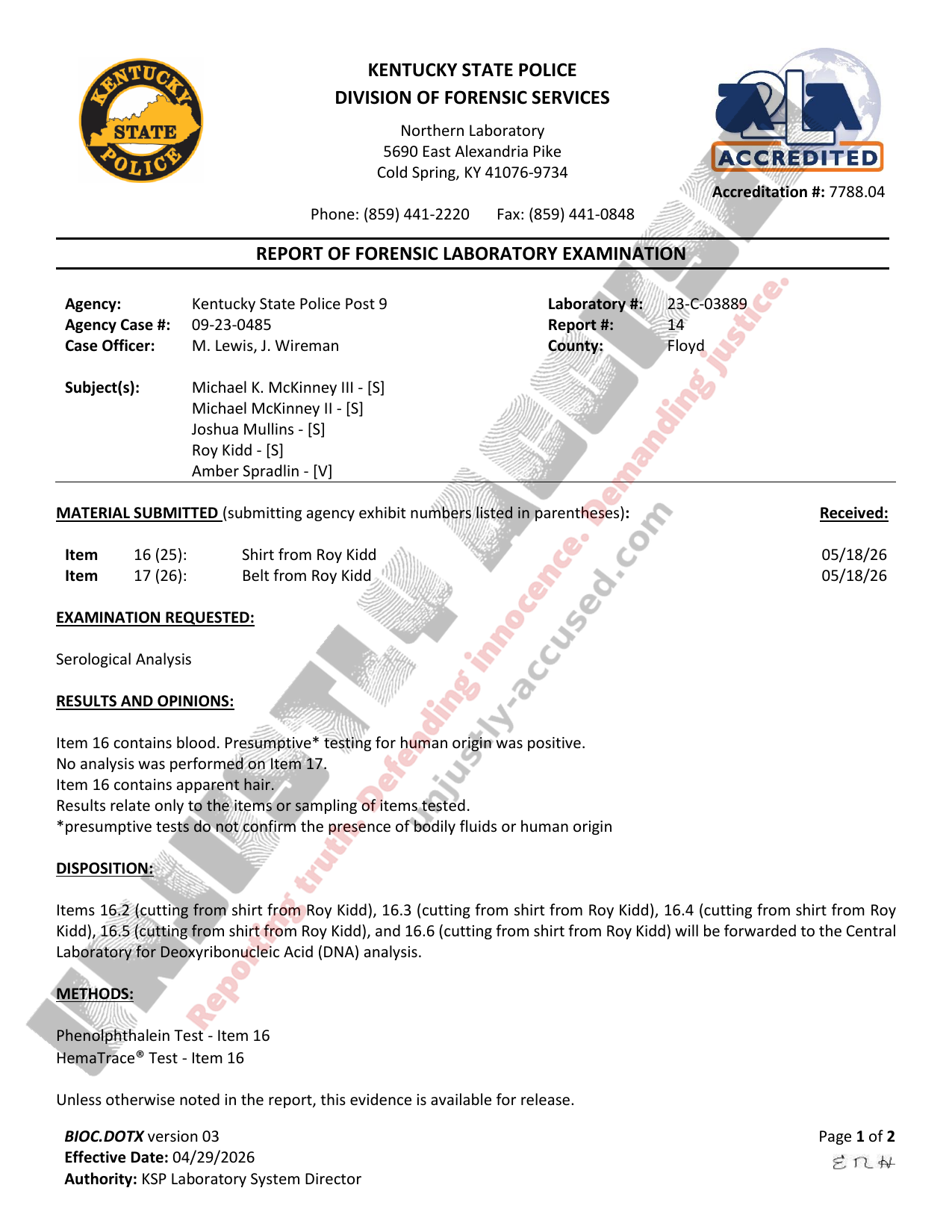
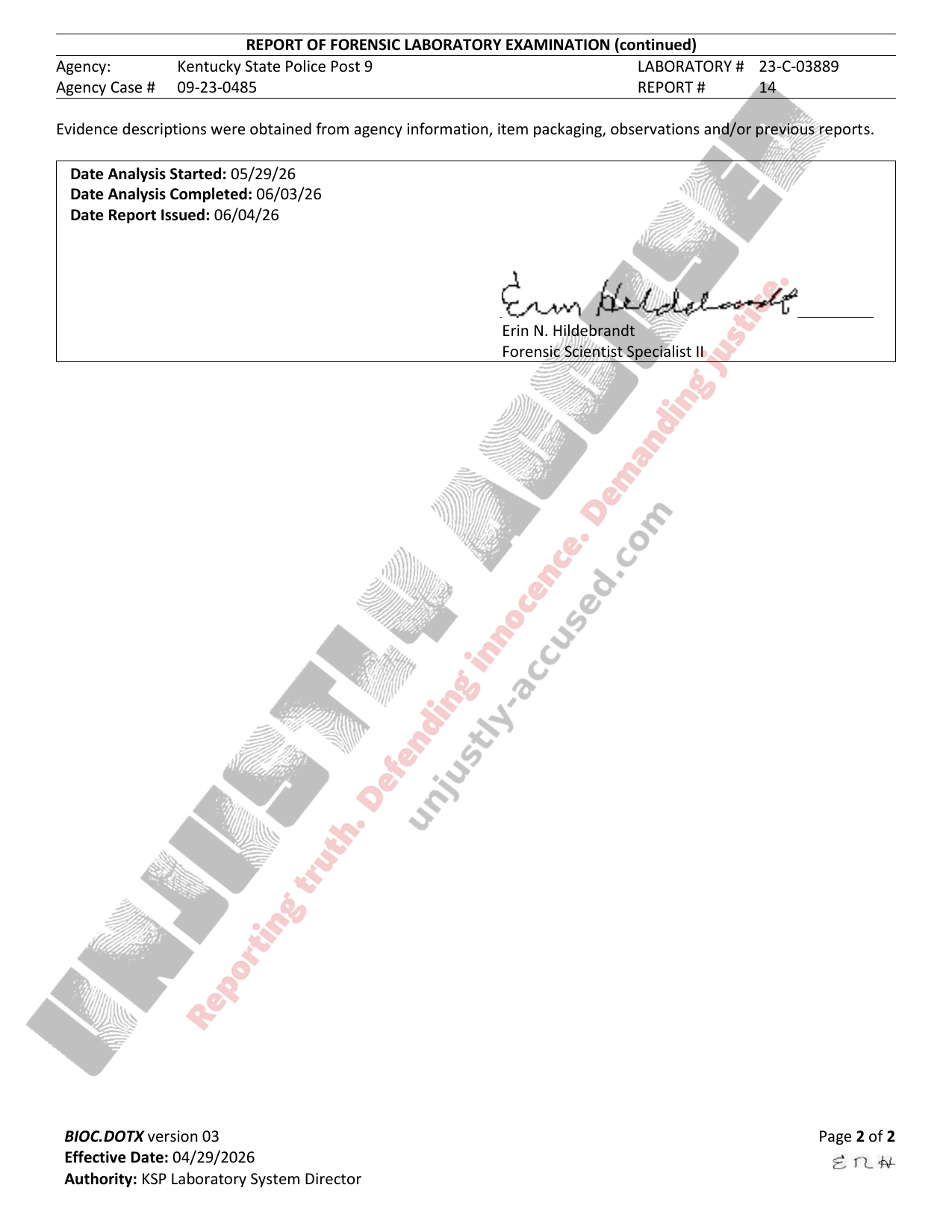
A Kentucky State Police lab report dated June 4, 2026, obtained by Unjustly Accused, shows how late some of this work is still happening. It is Report No. 14 under the case’s laboratory number, 23-C-03889, so at least 14 reports have now been issued in this one laboratory case. According to the report, the lab’s Northern Laboratory in Cold Spring received two items on May 18, 2026: a shirt and a belt, both listed as coming from Roy Kidd, the man who found Amber. That was nearly three years after her death, almost two years after the indictment and a week after McCann’s testimony. The report does not say when the items were collected or whether they had been examined before.
The lab ran presumptive tests on the shirt and reported that it “contains blood” and that “presumptive testing for human origin was positive.” It added its own caution that “presumptive tests do not confirm the presence of bodily fluids or human origin.” It noted apparent hair on the shirt and did no analysis on the belt. Five cuttings were to be forwarded to the Central Laboratory for DNA analysis. As of this writing, we have found no public report of a DNA result from those cuttings.
The report does not identify whose blood it might be or confirm that it is human. Blood on clothing worn by the person who discovered her would not, by itself, show anything about how she died. What the report does show is timing: clothing from a central witness was still entering the lab in the 35th month of the case, with DNA results pending as the January trial approached.
Why Now? A Witness’s Clothing, Nearly Eight Months Before Trial
If Roy Kidd is only a witness, why is his clothing being tested for blood and DNA nearly three years after Amber died?
Put the record side by side. In October 2024, the Commonwealth said the blood on Kidd’s clothing was his own, from a cut on his chin. In May 2026, Commonwealth’s Attorney Brent Turner described him as “a witness.” Yet on May 18, 2026, a shirt and belt listed as his arrived at the state lab. The agency on the report is Kentucky State Police Post 9, the post leading the investigation. And the lab lists him with the same “[S]” subject label it gives the three charged men. How do those facts fit together?
To be clear: Kidd has not been charged, he is presumed innocent, and nothing in the report shows wrongdoing by him. A lab’s subject label is not a charge or a finding. These are questions about what investigators think, and about the theory the Commonwealth has already taken to a grand jury.
Consider the timeline. Three men were indicted in summer 2024, and the case theory was set then. At the time, Turner said some test results were still pending, the Lexington Herald-Leader reported. That October, the Commonwealth said the blood on Kidd’s clothing was his. On April 30, 2026, it told the court that the blood and DNA evidence “could literally make or break the case for the commonwealth or the defendants.” Eighteen days later, a non-defendant’s clothing reached the lab.
If the theory was settled enough to charge three men, why does it still need this? Does an investigation confident in its theory send a witness’s clothing to the lab less than eight months before trial? Is the Commonwealth testing its own story, hedging it, or preparing a different one? The public record does not say. That silence is the problem.
There are ordinary explanations, and the record supports several: finishing the testing before trial, answering the defense’s October 2025 complaint that “only a single scrap” of the shirt had been tested for DNA, or exclusion testing to rule people out. Each of those explanations is its own indictment of the process. Testing that should have been finished in 2023 is being finished in 2026. And if this is exclusion testing, why was it still under way nearly two years after three other men were charged?
Amber’s family has waited through every delay. Three men were charged on a theory the Commonwealth was confident enough to present to a grand jury. If that theory is now moving, her family deserves to hear it from the Commonwealth, not piece it together from a lab report. Three years of uncertainty are the investigation’s own doing.
One batch of results, two readings
In an August 18, 2026 motion, M.K.’s attorney, Steven Romines, wrote that a lab report disclosed July 28 showed M.K.’s DNA “conspicuously absent from every item tested in the new report.” In a September 15 response, the Commonwealth wrote that the suggestion the latest report weakens its case “is simply not accurate.” It pointed again to the earlier fingernail testing, which it says produced a Y-STR profile matching the male McKinney line. On August 20, Turner told the Floyd County Chronicle & Times that the results so far had not changed the Commonwealth’s view of the case.
The lab reports are not public. As we have explained in Forensics on Trial and our look at secondary DNA transfer, the absence of a person’s DNA does not prove innocence, and its presence does not prove guilt.
Would a Trial Put the Investigation Under Oath?
In any criminal trial, the defense can cross-examine investigators and lab analysts about how evidence was preserved, collected and tested. Here that would likely mean questions about why the scene was released that night, what happened to the house and the couch before investigators came back, why some items reached the lab in 2025 and 2026, and what a delayed sample can and cannot show.
Both sides have already put the delay at the center of their arguments. In October 2025, the Commonwealth wrote, “Obviously, the Commonwealth cannot be ready for trial until all forensic testing is completed.” M.K.’s objection to that delay quoted that line and answered that “the issue of KSP’s laboratory backlog has been known throughout this entire case,” adding: “Deficiencies in the investigative process cannot be attributed to the Defendant.”
Would that scrutiny lead anyone to avoid a trial? Nothing in the public record suggests the Commonwealth is reconsidering, and we do not suggest anyone is acting in bad faith. The real question is whether the evidence, with the gaps created by the early handling of the scene and the long wait for testing, can carry the burden of proof beyond a reasonable doubt. Those process decisions made that question harder for everyone, including Amber’s family.
The Options, Explained Plainly
1. Trial on January 11
Judge Coleman has shown he will hold a date when a defendant insists. In April 2026, after M.K.’s counsel objected, he said, “Well, since Mr. [M.K.] McKinney objected to the trial being continued, it won’t be.” In a May 1 order he noted that M.K. “has objected to every motion for continuance filed by the Commonwealth and maintained his demand for a speedy trial.”
2. Another continuance
Under Kentucky Rule of Criminal Procedure (RCr) 9.04, a court may postpone a trial “upon motion and sufficient cause shown by either party.” The court has granted two DNA-related continuances already: in late 2025, and again in May 2026 after hearing sworn testimony from the lab. Whether a late final report would justify a third is the judge’s call.
3. Dismissal without prejudice
Under RCr 9.64, the Commonwealth’s attorney may dismiss an indictment “with the permission of the court” before the jury is sworn. A dismissal “without prejudice” is not an acquittal. The Kentucky Supreme Court explained in Commonwealth v. Sowell (2005) that an order dismissing an indictment “does not bar another indictment or prosecution,” although the Commonwealth must bring new charges rather than simply reopen the old case. Time would not run out, because under KRS 500.050, felony prosecutions are “not subject to a period of limitation and may be commenced at any time.” Murder and tampering with physical evidence (KRS 524.100) are both felonies. For Amber’s family, a dismissal of this kind would mean more waiting, not an ending. For the defendants, it would lift the charges without clearing them.
4. Amended or reduced charges
RCr 6.16 allows a court to permit an amended indictment before verdict only “if no additional or different offense is charged and if substantial rights of the defendant are not prejudiced.” In practice, a substantively different or lesser charge would generally require a new indictment or a negotiated plea. We have found no public indication that either is under consideration.
5. A plea offer
We found no public reporting of any plea discussions, and all three defendants maintain their innocence. Any plea would require a defendant’s agreement and the court’s acceptance.
6. Separate trials
RCr 8.31 requires the court to “grant separate trials of defendants or provide whatever other relief justice requires” when a joint trial would prejudice a party. Judge Coleman raised the idea himself in a May 1 order, writing that “a trial of the tampering charges with fewer defendants and fewer issues could ultimately be a better use of judicial economy.” Dr. McKinney’s September 29 motion now asks for a separate trial under RCr 8.31 if the prior-acts evidence is admitted, arguing that “its prejudicial effect cannot realistically be confined in a joint trial.” The court has not ruled.
What Amber’s Family Is Owed
Amber’s family supported the request to delay the trial in October 2025 so that testing could be finished. “We, the family are in agreement,” Dr. Hall wrote at the time. Each postponement since has cost them more time without an answer.
Whatever happens next, the reasons trace back to process decisions made in the first days and months. The scene was released before the work was done. Collection continued in a house that had been cleaned. Key items reached the lab months after the indictment, some as late as May 2026, and the lab was asked to process 145 items or more. The lessons are plain: hold the scene, submit key evidence early, and give the lab the resources to keep up.
M.K. McKinney III, Dr. Michael McKinney II and Josh Mullins are presumed innocent. Amber Spradlin deserves an answer that holds up, built on evidence that was protected, tested on time and presented in full.
We will update this article after the October 30 pretrial conference and as the remaining lab results are disclosed. If you have information about this case or another potential wrongful prosecution, you can use our story submission instructions; the ordinary web form does not guarantee anonymity.
Sources
- Order denying supplemental motion to modify non-financial bail conditions (work release), Commonwealth v. McKinney III, No. 25-CR-00223, Pike Cir. Ct. (entered Oct. 19, 2026), as published by Mountain Top Media, Oct. 20, 2026.
- Defendant Dr. Michael K. McKinney II’s Objection to KRE 404(b) Notice, Motion in Limine, and Alternative Motion for Separate Trial (filed Sept. 29, 2026)
- Kentucky State Police Division of Forensic Services, Report of Forensic Laboratory Examination, Report #14, Laboratory # 23-C-03889 (issued June 4, 2026), obtained by Unjustly Accused.
- Commonwealth’s Response to Defendant’s Motion for Bond Reduction and Work Release, No. 25-CR-00223 (Sept. 15, 2026), and Defendant’s Motion for Bond Reduction & Work-Release (filed Aug. 18, 2026), both as published by Mountain Top Media.
- Defendant’s Objection to Delay and Renewed Reassertion of Right to a Speedy Trial, No. 25-CR-00223 (filed Oct. 29, 2025)
- Floyd County Chronicle & Times, “Bond modified for man accused of killing Amber Spradlin” (Sept. 17, 2026)
- Floyd County Chronicle & Times, “Prosecution renews call for delay in Amber Spradlin murder case” (May 1, 2026); “Judge denies work release for man accused of killing Amber Spradlin” (Oct. 20, 2026); “Filings allege case … becoming ‘dimmer’; prosecution remains confident” (Aug. 20, 2026); “Judge suggests possibility of separate trials in Amber Spradlin murder case” (May 2026).
- Lexington Herald-Leader, Bill Estep, “Father, son arrested in high-profile Kentucky stabbing death. One charged with murder” (July 30, 2024).
- WYMT, “Commonwealth uses DNA to argue against bond reduction for Amber Spradlin’s accused murderer” (Oct. 24, 2024); “Motions mean another slight delay for Amber Spradlin murder trial” (May 1, 2026); “Amber Spradlin murder trial postponed until 2027” (May 11, 2026); “Judge denies work release for murder defendant in Amber Spradlin case” (Oct. 20, 2026).
- Kentucky State Police Post 9 news release on the Spradlin investigation (June 19, 2023; updated July 12, 2023 and July 30, 2024). Mountain Top Media, “Amber Spradlin murder case to go to trial May 11, after judge denies delay” (Apr. 23, 2026); “Prosecutor to ask for delay in Amber Spradlin murder trial” (Oct. 19, 2025). LEX 18, Spradlin case coverage (Oct. 2025).
- KRS 500.050 (time limitations); KRS 524.100; Kentucky RCr 6.16, 8.31, 9.04 and 9.64; Commonwealth v. Sowell, 157 S.W.3d 616 (Ky. 2005).