Author: Unjustly Accused
Amber Spradlin’s death was a tragedy. She was found dead on June 18, 2023, in a home on Arkansas Creek Road in Floyd County, Kentucky, and the people who loved her have waited more than three years for answers. Her cousin, Debbie Hall, has spoken of a family still trying to “grieve Amber the way that we need to.” Any honest look at this case has to begin there.
Justice for Amber requires a conclusion that rests on reliable evidence. This article is not about whether the investigation found someone to charge. It is about sequence: when the scene was controlled and when it was not, when charges came and when lab results came, and how a public account of guilt formed in between.
Michael K. “M.K.” McKinney III is charged with murder. His father, Dr. Michael K. McKinney II, and family friend Josh Mullins are charged with complicity to tampering with physical evidence. All three have pleaded not guilty and are presumed innocent. Trial is set for January 11, 2027, in Pike Circuit Court.
The Scene and the Story Moved at Different Speeds
Our earlier reporting reconstructed the physical timeline from warrant records and testimony:
- June 18, 2023: Investigators processed the home and, according to people present, released the scene at about 11:00 PM. No tape remained up, and the people still in the house were told they could clean.
- About two days later: A second warrant. By then the couch where Amber was found had been moved to the back porch, where it sat for about two days, and the house had been cleaned. The evidence log reads: “Knife found middle of couch on back porch.”
- About seven days later: A third warrant and a broad biological sweep of sinks, drains, traps and a door face in a home that had been cleaned and lived in for a week.
In a May 2026 motion, the Commonwealth said investigators spent three days processing a large home with “significant blood evidence.” Read against the warrant records, those three days were spread over a week, with the scene released in between. In plain terms, much of the processing took place at a scene that was no longer protected.
An Indictment Ahead of the Laboratory
On July 30, 2024, which Amber’s family counted as 408 days after her death, a grand jury indicted all three men. As the Lexington Herald-Leader reported, the indictment alleged that the defendants “removed, concealed or destroyed” the handle of a broken knife, disposed of the clothing M.K. was wearing, cleaned blood from two sinks, and removed a surveillance camera, a DVR and a computer hard drive.
These are serious allegations, and a jury will weigh them. Their timing still matters. As we have reported, DNA results for the blood in the kitchen and laundry sinks were not available when charges were filed. Amber’s clothing and a bloody handprint on a bedroom door were not submitted for testing until April 22, 2025, nine months after the indictment. Commonwealth’s Attorney Brent Turner said at the time of the arrests that “some test results … are still pending,” and he reminded the public that “the indictments are only accusations at this point.” That reminder was correct, and it bears repeating.
A superseding indictment later added a count alleging that the defendants “fabricated physical evidence by planting a knife in the couch … to suggest it was the murder weapon knowing it was not used in the crime.” The Commonwealth, then, does not say the porch knife is the weapon. It says someone placed it there to mislead. That is a claim about who handled the knife and when, and it is hard to establish for a couch that sat outside for two days after the scene was released. This raises difficult questions:
- Why was the couch not fully searched before the scene was released?
- What record shows who had access to the back porch during those two days?
- What evidence fixes when the knife was placed there and by whom, as opposed to a story that fits the defendants?
None of these questions shows the allegation is false. They show how much it depends on control of a scene that had already been given up.
Why Has the DNA Taken So Long?
The investigation’s most important questions are about whose blood is where, and the sources agree that answering them has been slow. They offer several reasons.
Volume. In May 2026, KSP forensic lab supervisor David McCann testified that the lab had received 145 items in five submissions, of 5, 41, 36, 13 and 50 items. He said the lab’s preferred batch is about ten items, and a batch that size typically takes at least eight months.
Process. McCann described one analyst per item to prevent cross-contamination. Each item is screened, pretested, tested, peer reviewed and reported in turn. Turner told the Herald-Leader in November 2025 that items had to be confirmed as blood before they could move on to DNA testing.
New technology. In December 2025, Turner said the lab had begun using a newer method that separates profiles in mixed DNA samples. A single analysis could generate a report of about 1,000 pages.
Capacity. Prosecutors have repeatedly described the lab as backlogged and understaffed, with pay and recruitment problems and a statewide caseload.
Estimates kept moving, and sources differ. In May 2026, WYMT reported McCann’s estimate for the final batch as “the end of September or early August.” The Floyd County Chronicle & Times reported the same testimony as “July or August.” Neither date held. On September 17, 2026, Judge Eddy Coleman ordered the lab to finish within 30 days. “Just tell them they’re gonna be done,” he said. That deadline falls around October 17. As of this writing, no completion has been publicly reported. The next pretrial conference is October 30. One outlet describes it as a hearing on DNA evidence, and another simply as a pretrial conference.
None of this was a surprise. As the defense wrote in October 2025, the backlog was known “prior to the Defendant’s indictment, prior to the Defendant’s bond hearing, and prior to the Defendant’s motion for a speedy trial.”
Bond Built on “Evidence Now Available”
M.K.’s bond was set at $5 million cash. We have previously noted that he had no criminal record. According to his lawyers, he drove to a Kentucky State Police post in Morehead to give a DNA sample voluntarily three days after Amber was found.
The defense’s October 2025 objection quotes the Commonwealth’s 2024 bond response: “all the evidence in the case strongly implicates Defendant M.K. McKinney.” It also quotes the court’s October 2024 order, which noted the Commonwealth’s position that “the DNA results and other evidence now available would support their indictment.” In 2025 the Kentucky Court of Appeals deferred to the trial court, “although the bond appears to be high.”
A year later the Commonwealth sought a continuance and wrote, “Obviously, the Commonwealth cannot be ready for trial until all forensic testing is completed.” The defense responded that the Commonwealth “did not wait for the completion of all testing before indicting the Defendant for murder, arresting and imprisoning him, and asking for and holding his bond at five-million-dollars.” Romines put it more briefly in court: “They can’t have it both ways.”
Relief came slowly. After roughly 16 months in jail, M.K. was released on December 18, 2025, under a restructured property-and-cash bond. His father posted it, including $450,000 in cash. M.K. was placed on GPS-monitored home incarceration. Reported figures differ between the December 1 hearing and the December 12 written order. In September 2026 the court released the cash component, which was reported as $500,000, and kept the property bond. A work-release request, opposed by the Commonwealth, is pending under seal.
In plain terms, the detention decisions rested on a case the Commonwealth later told the court it was not ready to try.
Results Arrive, and Each Side Reads Them Differently
Some results have now come back. According to the defense’s August 18, 2026, motion, the Commonwealth disclosed a new lab report on July 28. As the defense describes that report:
- Roy Kidd, who was in the home that night, was identified in male DNA on a cutting from discarded shorts and on several items of clothing.
- Dr. McKinney’s DNA was found on numerous items of clothing in his own house.
- Amber’s DNA was found on a blue towel next to the kitchen sink.
- M.K.’s DNA was “conspicuously absent from every item tested in the new report.”
“With each new piece of evidence,” Romines wrote, “the case against the Defendant becomes dimmer.”
The Commonwealth reads the same results differently. Turner said the results “have not changed their view of the case.” According to WMDJ, the prosecution’s response said Kidd’s DNA on clothing is consistent with testimony that he fell and cut his chin hours before Amber was killed. It also said the fingernail profile is consistent with McKinney family males and excludes Kidd and Mullins. Earlier, in October 2024, the Commonwealth filed photographs it said showed scratch marks on M.K.’s arm. In September 2026 it gave notice of two prior alleged knife incidents, one first disclosed to police in July 2025, more than two years after Amber’s death. Dr. McKinney’s lawyers have moved to exclude that evidence or sever his trial. These are claims, not findings, and they will be tested in court.
The lab reports themselves are not public. What is known comes through filings from parties with a stake in how they are read.
Two points hold either way. First, the newly disclosed results are the kind of evidence that was still outstanding when M.K. was charged, held on a $5 million bond and widely treated in public as guilty. Second, the absence of someone’s DNA on tested items does not prove that person was not involved, just as its presence would not prove involvement. Dell Crawford’s case is a reminder that an absence of DNA has to be interpreted honestly. It must not be ignored, and it must not be overstated.
One Premise Holding Up Three Cases
At the May 2026 hearing, Turner explained that the tampering charges rest on the proposition that M.K. was the killer and that his co-defendants tampered with the scene “to help hide that.” In plain terms, the entire three-defendant case depends on a single conclusion. If that conclusion is wrong, the alleged cleanup, the missing cameras and the porch knife all need another explanation, and none has been examined in public.
The Commonwealth has acknowledged the competing theory. It wrote that only two people were bleeding that night, Amber and Kidd, and that the case may come down to whom the jury believes was responsible. The defense has pointed to Kidd. Kidd, who discovered Amber’s body, has not been charged. The Commonwealth says the fingernail testing excludes him and that he has been offered no deal. We draw no conclusion about him. The narrower point is that the question both sides treat as central, whose blood is where, was still unanswered when the public story of guilt took hold.
A Verdict Formed Online First
In May 2025 the case was moved from Floyd to Pike County because of intense public attention. The court barred demonstrations within 25 feet of the courthouse and banned courtroom apparel supporting any party. Defense filings describe a “trial-by-Facebook” that called M.K. “the murdering Satan.” Co-counsel Randy O’Neal said it was “long past time to litigate this case in a courtroom rather than on social media.” Amber’s family has also described online commentary as “a mine field of misinformation.” When every side distrusts the public conversation, the formal record matters more.
What the Record Shows vs. What Gets Inferred
What the record shows:
- The scene was released the night of June 18, 2023, and was processed again after it had been cleaned and opened to outside access.
- The porch knife was recorded after the couch had sat outside for two days. The Commonwealth now says that knife was not the weapon.
- Charges came on July 30, 2024. Key items were submitted for testing in 2025, and results were still arriving in July 2026.
- Bond was set and defended on the basis of “evidence now available.” The Commonwealth later said it could not be ready “until all forensic testing is completed.”
- A 30-day completion order was issued September 17, 2026.
What gets inferred:
- That blood in the sinks shows a cleanup by these defendants rather than an unknown sequence of events.
- That the porch knife was planted by these defendants, during a period when no one controlled access.
- That detention reflected the strength of the evidence.
- That every outstanding test will confirm the theory rather than complicate it.
Confidence is not the same as certainty. The first list comes from documents. The second comes from a theory the documents have not yet confirmed.
Why Sequence Matters
Nothing here establishes what happened in that house. The remaining results may strengthen or weaken the Commonwealth’s case. The case remains open, and all three defendants remain presumed innocent.
The order of events is already on the record. The scene was released before it was finished. Charges came before results. The bond rested on evidence the state later called incomplete. A public verdict formed before a jury was seated. Lukis Anderson’s case shows how quickly a narrative can form around early evidence and how slowly it gives way. When the process moves faster than the evidence, the public story of guilt can move faster than the proof.
Amber Spradlin deserves an answer that holds up. A conclusion reached in the wrong order may not.
We will continue to follow this case as testing is completed and the January 2027 trial approaches. If you have information related to the McKinney case or any other potential wrongful prosecution, we encourage you to share it securely at Unjustly-Accused.com.
Sources
- Floyd County Chronicle: Bond modified; judge orders 30-day DNA completion (Sept. 17, 2026)
- WYMT: Amber Spradlin murder trial postponed until 2027
- Mountain Top Media: Spradlin murder suspect granted second bond reduction
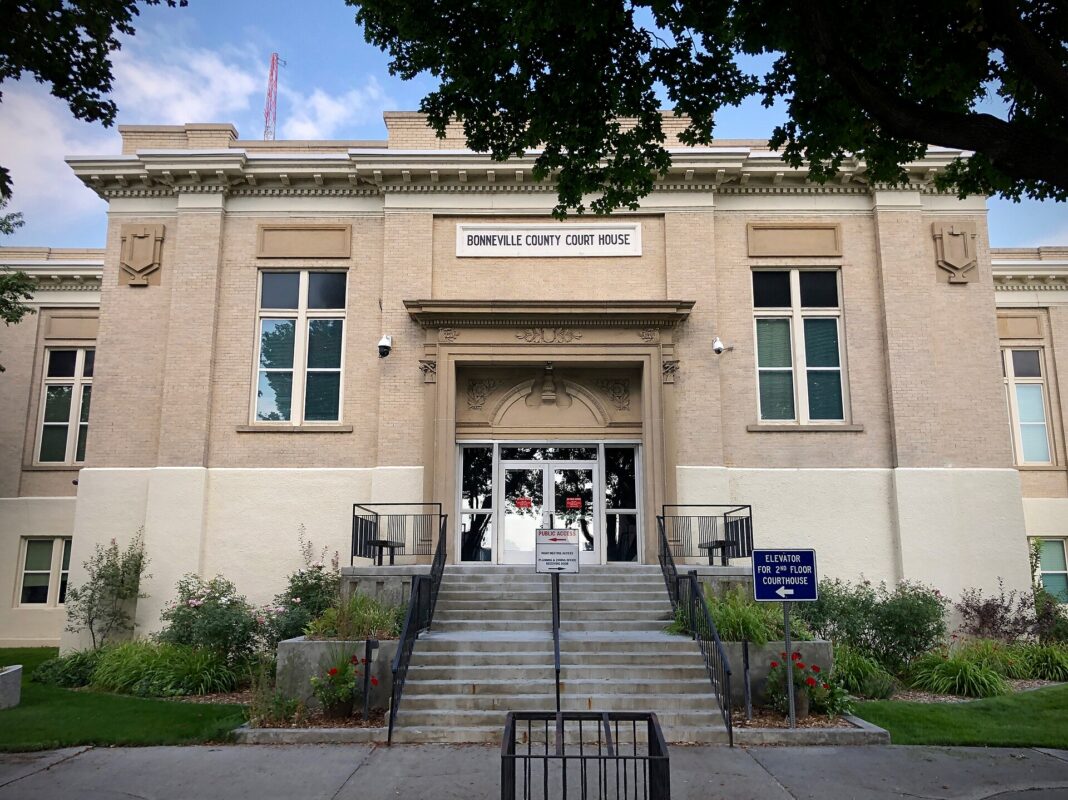
Featured image: Courthouse exterior. Photo via Wikimedia Commons / site credit.