

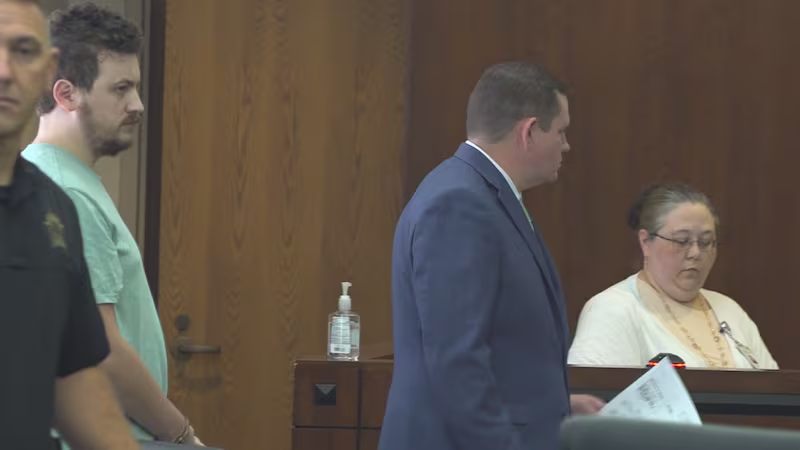
When Unjustly Accused first reported on the troubling inconsistencies in the murder prosecution of Michael K. McKinney III, the story drew thousands of readers and ignited a debate over how forensic science can be both weapon and shield in the courtroom. Now, newly obtained defense filings and a 30-page independent DNA review reveal a deeper problem, one that strikes at the heart of Kentucky’s criminal justice machinery.
A Five-Million-Dollar Presumption
The court set McKinney’s bond at $5 million cash, an amount reserved for defendants accused of the most heinous crimes or those deemed an extreme flight risk. Yet McKinney had no criminal history, voluntarily provided a DNA sample to investigators just three days after the victim, Amber Spradlin, was found, and has remained in custody for over two years.
The defense’s renewed motion to reduce bond describes the prosecution’s case as built on “evidence now available,” a phrase that has since become an indictment of the prosecution’s own confidence. The Commonwealth, once boasting that DNA evidence made for a “strong case,” is now requesting delays to “gather more evidence.” The defense argues that this reversal is a tacit admission that the case is far weaker than advertised.
‘Five-Million-Dollar Evidence’ and a Withering Speedy-Trial Fight
In a separate filing, McKinney’s attorneys object to the Commonwealth’s request for a continuance, calling the delay “a foreseeable consequence of the prosecution’s own choices.” The motion cites repeated assertions before both Circuit and Appellate courts that the state already possessed a strong evidentiary case.
If that were true, defense counsel argues, the Commonwealth should be ready to prove it. “If the existing evidence is good enough to keep him in custody, it is good enough to try the case,” attorney Steven Romines wrote.
The filing also notes a concerning pattern: the same social-media campaign that demanded “Justice for Amber” has saturated the local community with hostility toward McKinney. The group’s administrator, allegedly a close friend of alternate suspect Roy Kidd, helped fuel public outrage, even as Kidd’s own clothing tested positive for large amounts of blood. Yet, according to the expert DNA review, only “a single scrap” of Kidd’s blood-soaked shirt and belt were tested for DNA, leaving the remainder unexamined.
The Forensic Reality Check
The newly obtained ExpertDNA Solutions report, commissioned by the defense, paints a damning picture of the Kentucky State Police laboratory’s handling of evidence. Conducted by two veteran forensic scientists, Maria Tsocanos and Jaime Rodrigues, the 30-page assessment identifies eight major procedural and scientific flaws in the state’s DNA work:
Contaminated controls ignored. A reagent blank, meant to confirm no foreign DNA entered the sample set, was contaminated but analysts used it anyway. The report calls this a direct violation of KSP’s own Standard Operating Procedures.
Potential cross-contamination. Known samples from McKinney and his father were run on the same plate as the victim’s nail clippings, raising “the potential for carryover/contamination” that could explain how McKinney’s Y-chromosome markers appeared in the sample.
Key evidence consumed. Swabs from Amber Spradlin’s fingernails were fully consumed during testing, leaving nothing for independent retesting, an irreversible breach of good forensic practice.
Miscalculated statistics. The Y-STR mixture, which supposedly tied McKinney’s lineage to the sample, was reported as “463 times more likely” to match a McKinney than a random male. The independent experts recalculated that probability at 1 in 451, a rate so common that two matches appeared in a U.S. database of just 29,207 male profiles.
Unsecured custody of evidence. More than 40 items remained in analysts’ personal custody for over 90 days, well beyond the lab’s own 90-day limit, with no documentation of secure storage.
Incomplete testing of alternate suspect’s items. Only one small stain from Kidd’s heavily bloodied shirt and belt was tested. The rest of the stains, potentially critical in determining the true source of the blood, remain unexamined.
Taken together, the report describes a laboratory system “deviating from best practices” and “failing to document quality issues or corrective actions.” It also highlights the growing scientific understanding of secondary DNA transfer, the inadvertent movement of genetic material through indirect contact. The expert reviewers warn that given McKinney’s home was the location of the alleged crime, the presence of familial DNA could easily be explained by innocent transfer.
The Bigger Picture: Contamination and Conviction
This is not the first time a forensic laboratory’s contamination issue has altered the course of a criminal case. A 2025 study cited in the report recounts a case in which an innocent man was falsely linked to a sexual assault through secondary transfer via a police station blanket. That finding echoes McKinney’s defense argument: the state’s “smoking gun” Y-STR result may be no gun at all, but a trace of familial DNA moved through ordinary contact.
What makes McKinney’s case alarming is not just the scientific uncertainty. It is the persistence of a prosecution unwilling to confront it. Even as the Commonwealth admits its evidence is incomplete, McKinney remains behind bars, awaiting a trial that keeps receding further into the future.
A System Under the Microscope
At its core, the McKinney case exposes a systemic vulnerability: when forensic labs fail to follow their own safeguards, the presumption of innocence collapses under the weight of bad science. As the defense’s filings make clear, “deficiencies in the investigative process cannot be attributed to the Defendant.” Yet those deficiencies are now the only thing standing between McKinney and his right to a fair trial.
The question Kentucky’s courts must now answer is whether the justice system can hold itself to the same evidentiary standards it demands of the accused.
If you have information related to the McKinney case or any other potential wrongful prosecution, we encourage you to use our story submission instructions; the ordinary web form does not guarantee anonymity
Click the “Submit a Tip” button on our site. Your leads matter.


My girlfriend and I have often wondered why Roy Kidd wasn’t arrested. The trial needs to be moved to another area. The legal system there is corrupt, plus there is no way for any of the McKinney family to get a fair trial there. The average I.Q. in that county is pretty low, and the people there are easily brainwashed and the “Justice For Amber cult has done their darndest to brainwash most the potential jury pool into believing that the McKinneys are all guilty before their trials. There are others who were present at the house that night who haven’t been publicly named? Why is this???